A new study published in Science shows that a network built from atoms and light particles could improve the way artificial intelligence handles memory.
It works as an associative memory, like how you can still recognize a person’s face in a blurry photograph. This new network pieces together full memories from partial information.
A Better Memory for AI
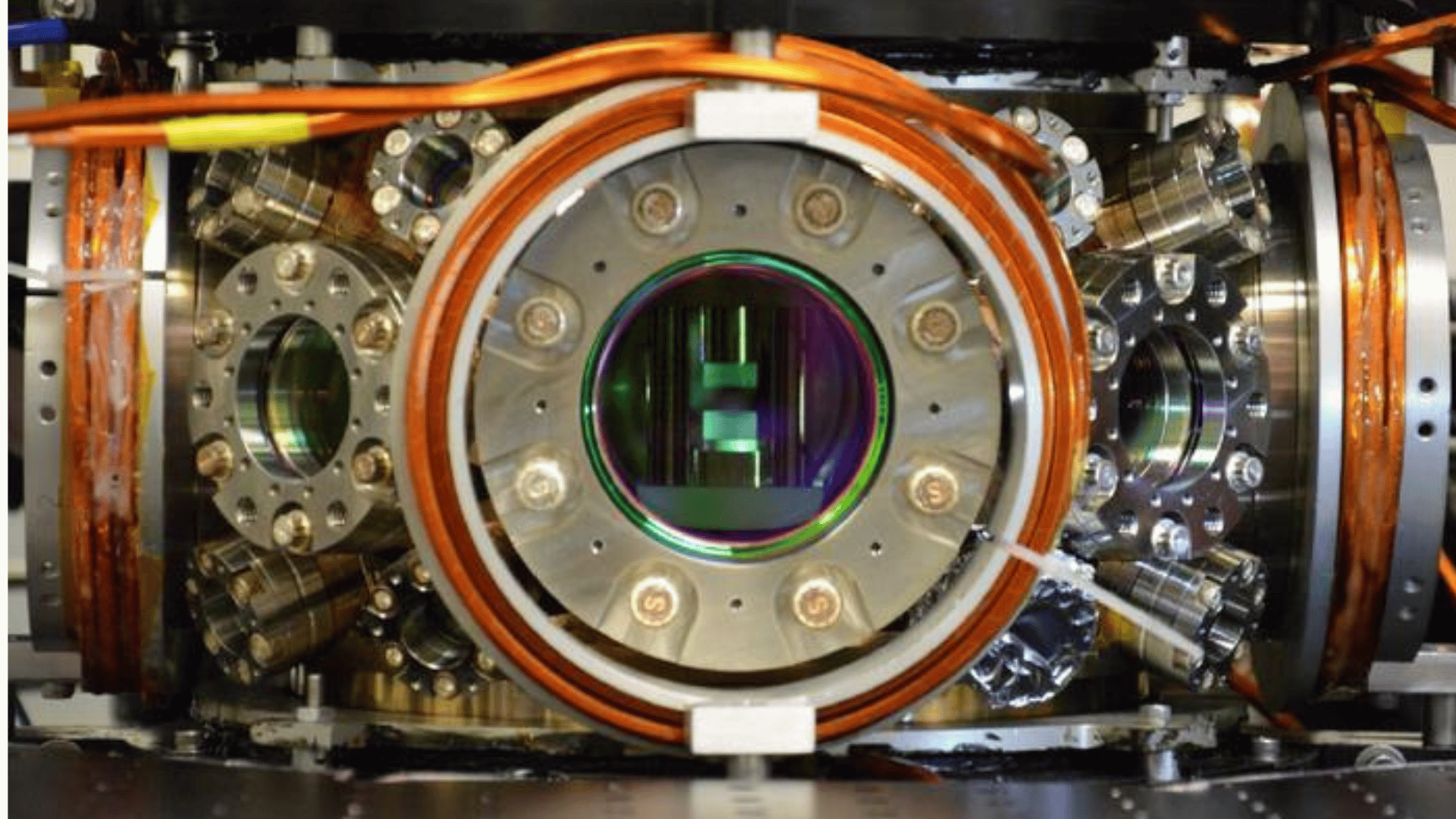
The researchers built a “quantum-optical spin glass.” Normally, a magnet has atoms that all point in the same direction. But in a spin glass, the atoms get stuck pointing in random directions.
In 1982, physicist John Hopfield showed these random spins could store memory patterns. However, traditional networks fail when they hold too many memories. The random spins create a cluttered environment, and the network loses track of information.
The research team used laser tweezers to trap extremely cold clusters of atoms between two curved mirrors. They bounced particles of light (photons) back and forth. These photons connected the atoms, acting like the synapses in a human brain, allowing the network to recall memories even in a cluttered state. It held up to seven times more memory than a traditional network of the same size.
Advertisement
“We can now make neural networks at the atomic level, and they adjust themselves in a way that is somewhat similar to how we believe our brains learn,” said Benjamin Lev, the study’s senior author and Stanford professor.
Improving and Scaling
The researchers noticed the photons pushed the atoms to change their connections. This shows short-term plasticity, which resembles how a human brain rewires itself to learn new things.
This might work for future computing, but has limitations. The system uses extremely cold atoms trapped in a vacuum chamber, so it isn’t ready for practical use just yet.
“We now have a proof of principle of a physical network that adjusts itself in a way a learning system would, and if we can improve and scale that up, AI hardware might become far less power hungry to train,” Lev said.
Since the system stores more memories in a small space, AI technology could eventually use far fewer resources.
“This teaches us a little bit more about how physical systems can compute, not just with the classical laws of physics, but also with quantum laws,” Lev said. “It’s great to shoot for these applications, but we’re also doing this because we want to know more about how nature works.”
 Read Exclusive Stories
 Bookmark & Save Articles For Later