Scientists used Frontier, the world’s fastest supercomputer for open science, to build an AI model that can map out magnetic turbulence in plasma with a level of detail we haven’t seen before. These findings could help us understand how stars are born or even help us build better nuclear fusion reactors here on Earth.
An Advanced AI Model
Turbulence in space involves plasmas, electrically charged fluids, and magnetic fields. This creates “magnetohydrodynamic turbulence,” which is basically a massive cosmic storm. These storms shape entire galaxies and affect Earth’s magnetic field.
The problem is that these systems are incredibly messy. In the past, scientists used math shortcuts to try to predict how these fluids move, but those shortcuts usually left out the tiny details that actually matter.
“The more chaotic the system, the harder to simulate it,” said Eliu Huerta, a computational scientist at Argonne National Laboratory. “Traditional AI models struggle to reproduce these patterns for the same reason: because these interactions are so complex and computationally demanding to reproduce, the models smooth out the fine details that define turbulence and we lose the insights we seek.”
Advertisement
A Two-Step Process
To fix this, the team used a two-part strategy. They used one type of AI to handle the big, broad physics and a second type, a generative “diffusion model,” to fill in the tiny, swirling details. Basically, one artist draws the outline, and the other fills in the intricate textures.
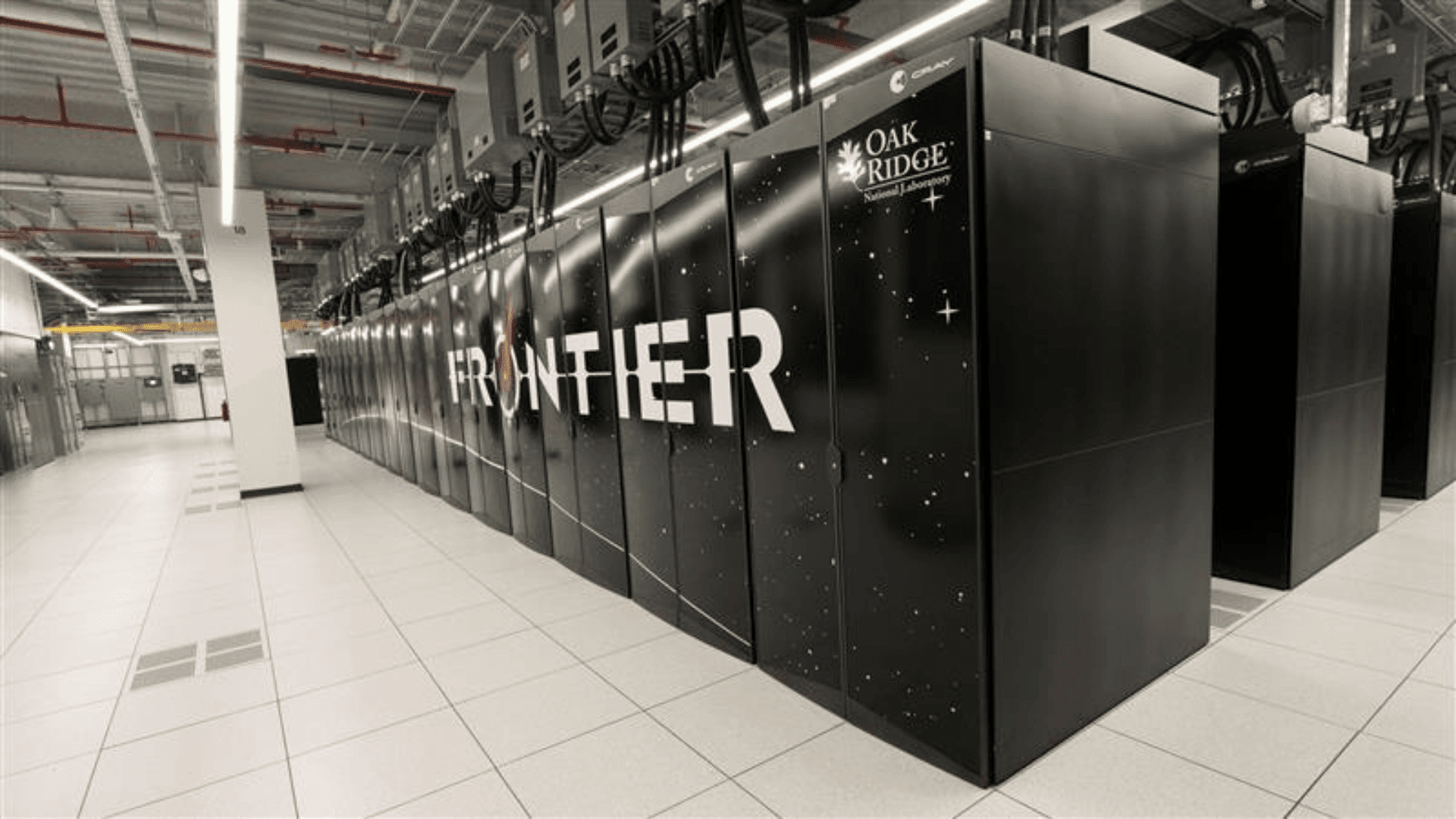
Frontier, located at Oak Ridge National Laboratory, can do 2 quintillion calculations per second. That speed let the team run thousands of simulations to train the AI.
“Frontier was a lifesaver for us,” said Semih Kacmaz, the graduate student who led the study. “We used Frontier to generate high-fidelity datasets to train our diffusion model and to train our physics-informed neural operators. Those steps required tremendous amounts of computations that had been a bottleneck for us, and Frontier made them practical.”
Now, the model can predict plasma turbulence in just seconds. Additionally, it is much more accurate, cutting down errors by more than half compared to older methods.
“This kind of capability has long been the dream of astrophysicists and many other scientists,” Huerta said. “It’s the first time this level of insight via AI has been achieved for systems of this complexity.”
 Read Exclusive Stories
 Bookmark & Save Articles For Later