A new study that simulated Saturn’s past suggests that its rings and its largest moon, Titan, may have formed as the result of a collision with another moon.
The Origins of Saturn’s Rings and Largest Moon
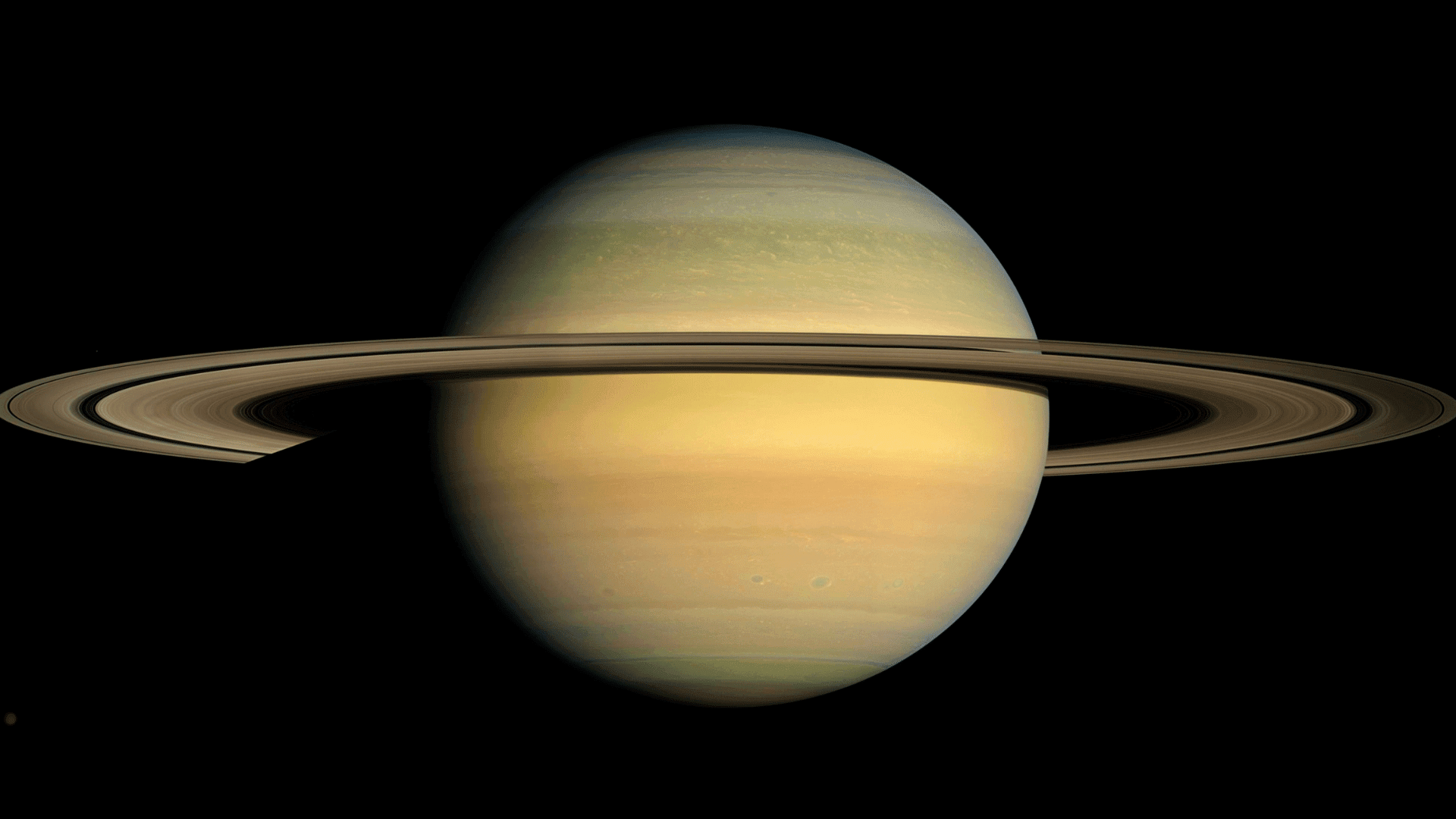
The research, which was led by the SETI Institute, could solve the mystery of the young age of Saturn’s rings and Titan’s unusual orbit. The idea uses data from NASA’s Cassini mission, which orbited Saturn for 13 years and measured Saturn’s internal mass distribution.
That data shows that the planet’s mass is more concentrated toward its center, which changes the rate of its slow spin-axis wobble or precession. This was different than what scientists had expected to find, which was that Saturn’s precession would match that of Neptune’s. Researchers believe this could be explained by Saturn once having an extra moon that was later expelled after interacting with Titan, breaking apart to form the rings.
Hyperion, a small moon that is locked in an orbital resonance with Titan, was crucial in helping researchers develop this theory.
Advertisement
“Hyperion, the smallest among Saturn’s major moons provided us the most important clue about the history of the system,” said Matija Ćuk, a research scientist who worked on the study.
In some of the simulations, Hyperion was lost when the extra moon became unstable. Once the team realized that the Titan-Hyperion orbital lock is only a few hundred million years old, which is relatively young in a cosmic sense, they also realized the timing of its formation overlapped with the disappearance of a possible extra moon.
“If the extra moon merged with Titan, it would likely produce fragments near Titan’s orbit. That is exactly where Hyperion would have formed,” stated Ćuk.
This new theory proposes that Titan formed from a merger between an almost Titan-sized moon and a moon smaller than Hyperion. The proposed collision could explain Titan’s smoother surface, limited supply of craters, and its elongated orbit that’s slowly becoming circular. Researchers also believe that the smaller moon may have tilted the orbit of Lapetus, another distant moon.
The study was accepted for publication in The Planetary Science Journal.
 Read Exclusive Stories
 Bookmark & Save Articles For Later