NASA’s Hubble Space Telescope has recently taken a look at the full Crab Nebula, a quarter-century after its first observations of the supernova event.
New Observations of The Crab Nebula
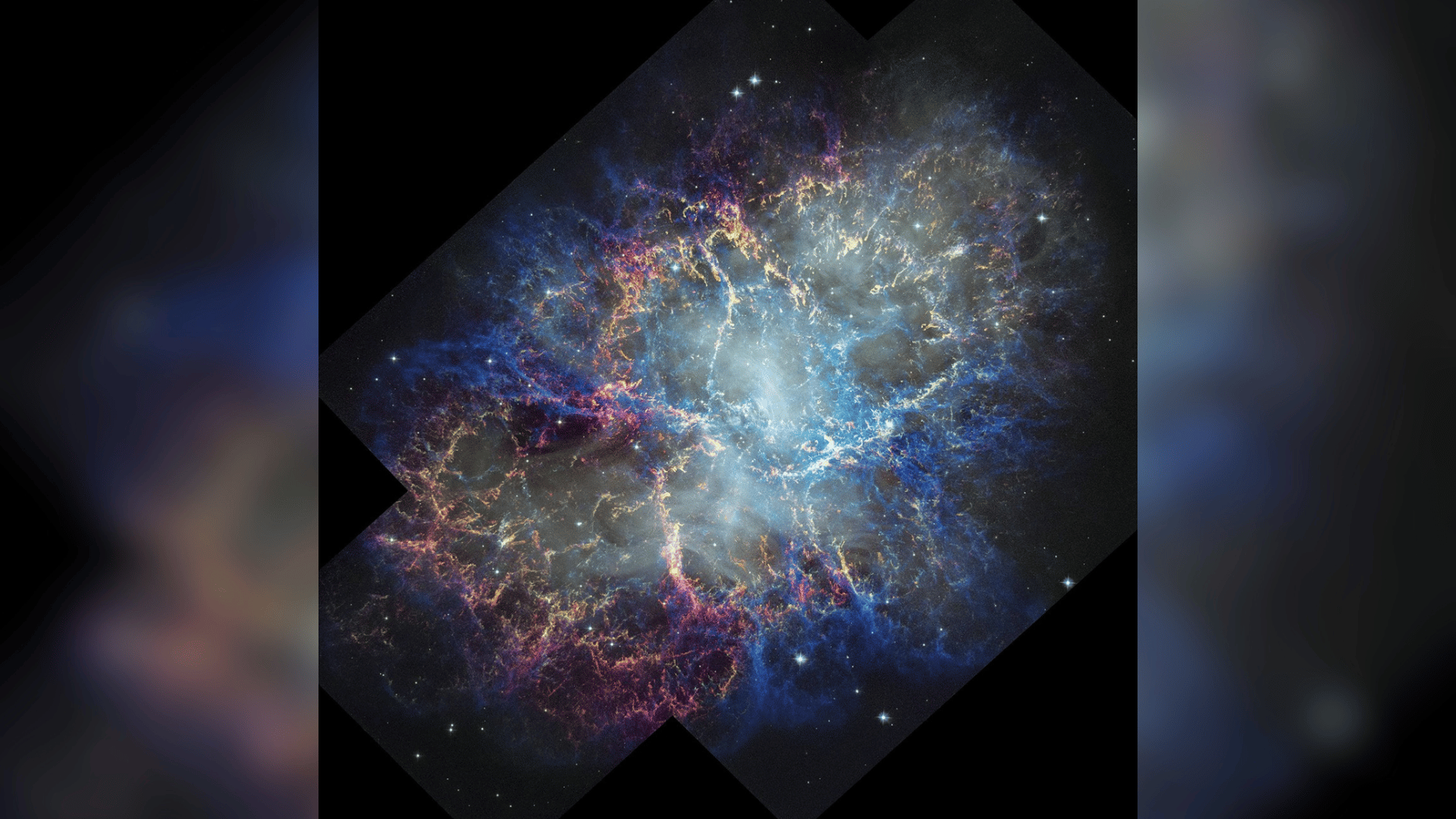
The new and detailed look at the supernova shows how the area has evolved over Hubble’s lifetime. The Crab Nebula is the aftermath of SN 1054, which is located 6,500 light-years from Earth in the constellation Taurus.
“We tend to think of the sky as being unchanging, immutable,” said astronomer William Blair of Johns Hopkins University, who led the new observations. “However, with the longevity of the Hubble Space Telescope, even an object like the Crab Nebula is revealed to be in motion, still expanding from the explosion nearly a millennium ago.”
First discovered in the mid-18th century, the heart of the Crab Nebula contains a pulsar, or a rapidly rotating neutron star, which powered the area’s expansion. The new image captures the nebula’s complex filamentary structure and its outward movement over 25 years, at a pace of 3.4 trillion miles per hour.
Advertisement
Hubble’s longevity and resolution make it the only telescope capable of capturing these detailed images. The telescope’s 1999 image of the Crab was reprocessed to better compare with the new image.
The color differences between the Hubble images showcase changes in the density of the gas, chemical composition, and local temperature. According to Blair, the filaments around the edges of the nebula seem to have moved more than those at the center.
The modern, higher-resolution Hubble observations also provide better insights into the 3D structure of the Crab Nebula, which can be difficult to fully understand in a 2D image.
“Even though I’ve worked with Hubble quite a bit, I was still struck by the amount of detailed structure we can see and the increased resolution with the Wide Field Camera 3, as compared to 25 years ago,” Blair said.
A paper detailing the new Hubble observation was published in The Astrophysical Journal.
 Read Exclusive Stories
 Bookmark & Save Articles For Later