A new set of experiments, published in the journal Science, showed that a bonobo named Kanzi was able to play along with a game of make-believe, providing the first evidence that humans aren’t the only animals capable of using their imagination.
Can Primates Play Pretend?
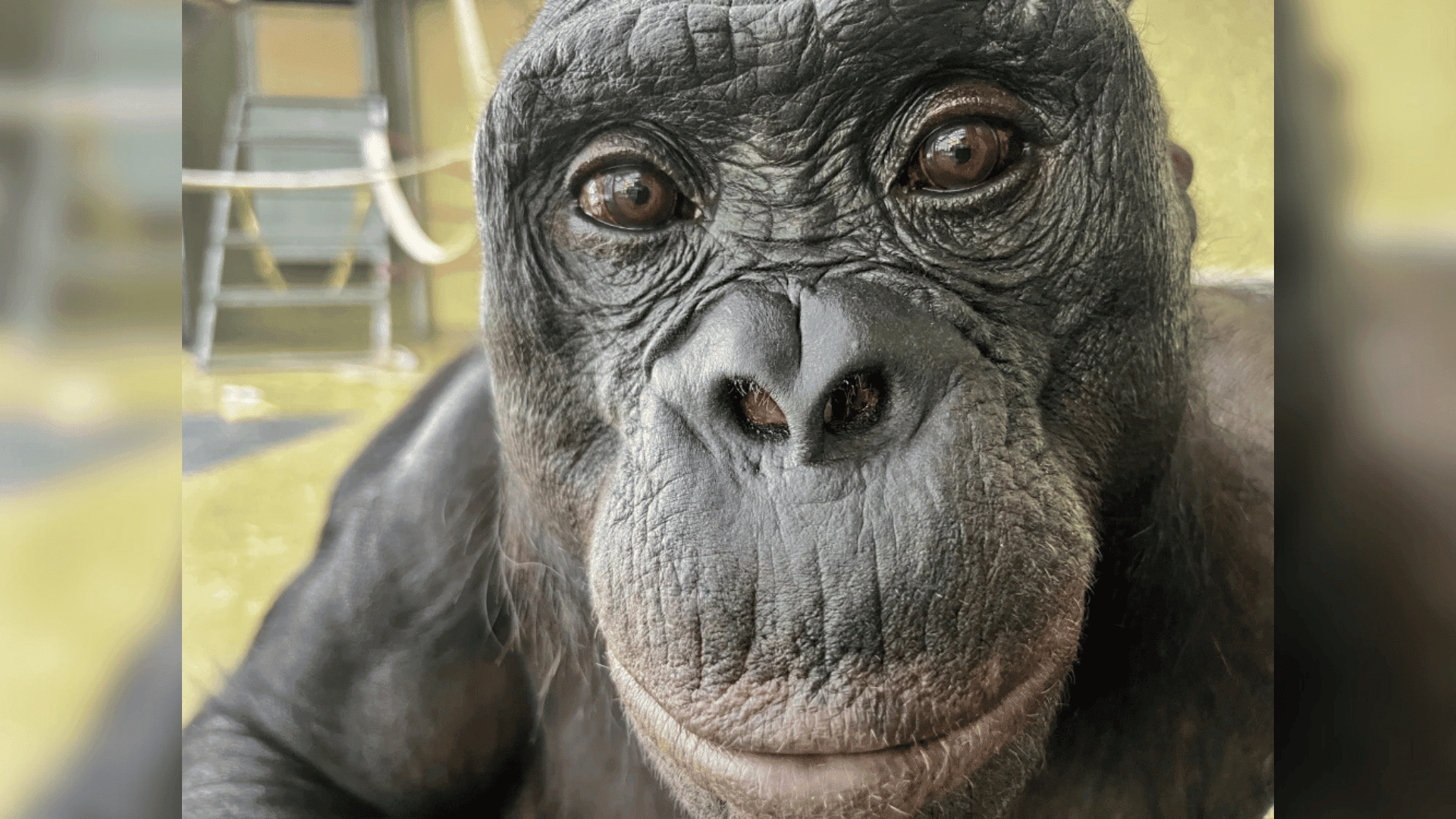
Presenting the test as part of a game, a team of researchers offered Kanzi invisible juice and grapes, similar to a child’s pretend tea party. The results showed that the primate was able to track the invisible juice as it was being “poured” between bottles and pitchers.
“He’s able to follow along and track the location of a pretend object, but at the same time, he appreciates that it’s not actually there,” said Chris Krupenye, an author of the study and an assistant professor of psychological and brain sciences at Johns Hopkins University.
Though scientists previously assumed that imagination or the ability to consider multiple realities was an exclusively human trait, some observations of behaviors in primates called this into question. These include young chimpanzees playing with a “log doll” and moving imaginary blocks.
Advertisement
“We think of our ability to imagine other worlds or other objects, or imagine futures, as one of these rich features of human mental life that are presumed to be unique to our species,” Krupenye said. But apes “might share some of the foundational cognitive machinery that will enable at least some degree of imagination.”
The study involved staging three distinct experiments. First, researchers pulled out two bottles and a pitcher, all empty and transparent. They poured imaginary juice from the pitcher into both glasses, and then poured one pretend glass of juice back into the pitcher. They would then ask Kanzi which glass contained the juice.
Kanzi pointed to the cup that would still have contained juice, if it were real, 34 times out of 50, or 68% of the time. That’s a common “success rate” in cognitive testing for apes, according to Krupenye.
In the second experiment, Kanzi was presented with a cup of actual juice alongside a cup of pretend juice and asked which he wanted. He pointed to the glass with the real juice 14 out of 18 times, indicating he could distinguish between the real and fake juice.
Last, the researchers conducted a similar test to the first one but used imaginary grapes instead of juice. This had similar results, leading researchers to conclude that Kanzi was able to distinguish between imagination and reality while keeping both in mind.
According to Jan Engelmann, an associate professor of psychology at the University of California, Berkeley, who was not involved in the study, the experiments support the idea that apes can engage in “secondary representations”, cognitive processes in which the mind models multiple scenarios, including hypothetical ones, and complex thought processes such as planning, reasoning, and inferring cause and effect.
 Read Exclusive Stories
 Bookmark & Save Articles For Later