Yes, provided you buy a machine rated for it. A robot mower 1 acre setup is well within reach of current technology, but an acre is 43,560 square feet, roughly four to seven times the turf on a typical suburban lot, so an entry-level model bought on price will not finish the job. The specifications that matter change once you cross about half an acre.
The more useful question is what an acre demands that a smaller lawn does not. Runtime becomes the constraint on the whole system, boundary setup goes from an afternoon to a serious job, and terrain a small lawn never has started stopping the machine.
An acre of land is rarely an acre of grass
Before shopping, measure what you actually mow. A one-acre property with a house, driveway, shed and planting usually has between 25,000 and 33,000 square feet of real turf once everything else is subtracted, which is enough of a difference to change which machines are in contention.
Trace your lawn in a satellite mapping tool rather than estimating, then compare that figure to the maximum recommended area on each spec sheet and leave about 15% headroom. Most machines sold for a robot mower 1 acre job quote a ceiling above 33,000 square feet, so a measured lawn often sits comfortably inside the rating even when the deed says a full acre.
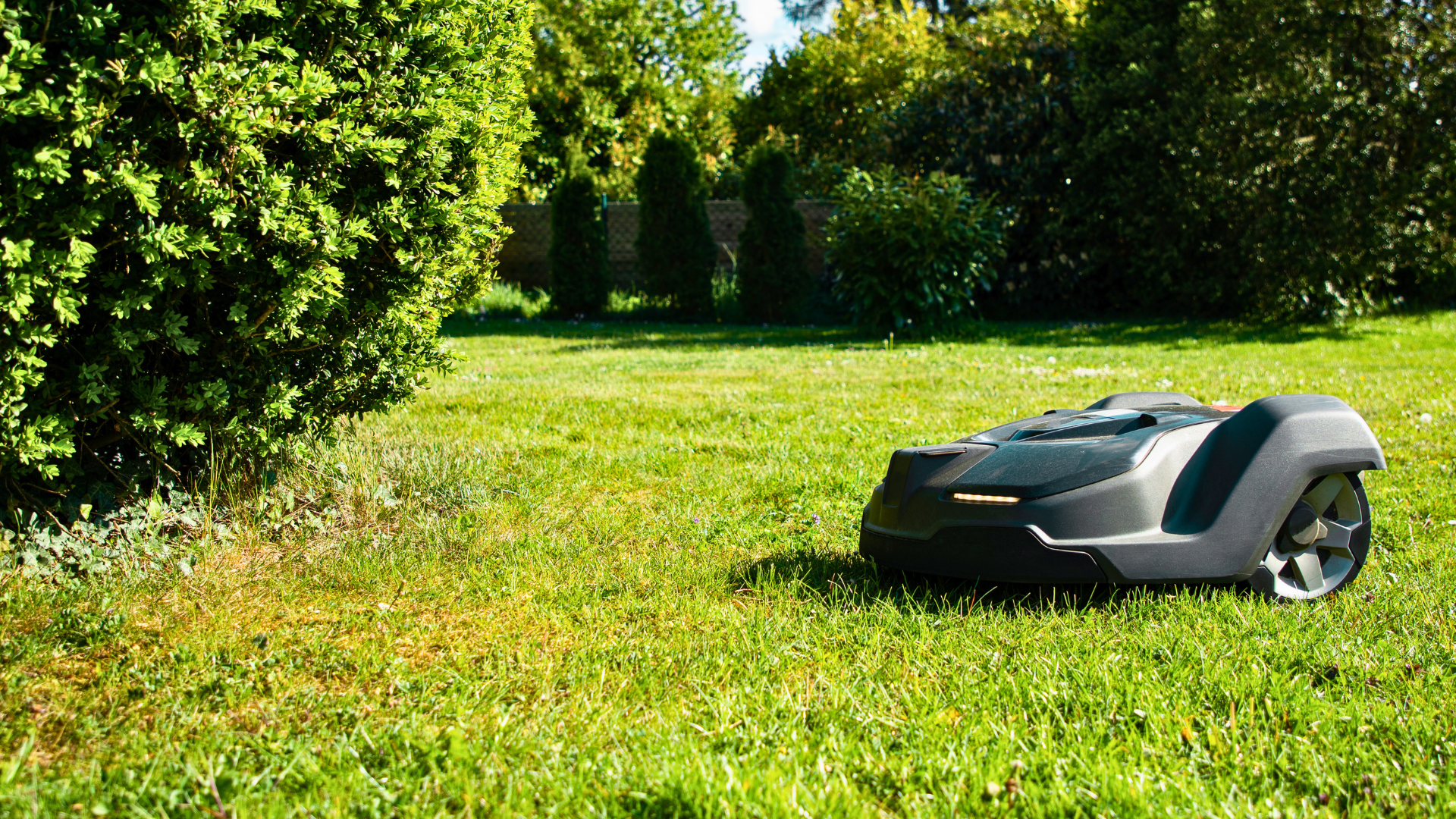
How long an acre actually takes
A robot mower does not cover an acre in a single run. It works in sessions, returns to the dock when the battery drops, charges, and picks up where it left off, so a full pass typically spans several days. That matters less than it sounds, because nothing needs supervision and the lawn stays at a constant height instead of swinging between long and short.
Check the full cycle rather than runtime alone. A machine with 60-minutes of mowing and a 90-minute charge works for about 40% of the time it is switched on, while the same runtime with a 45-minute charge works for 57%. On an acre that gap decides whether the schedule holds through heavy growth.
Boundary wire becomes a serious job at this scale
An acre needs roughly a thousand feet of perimeter cable before exclusions, and every bed, tree ring and structure adds more. Laying it is a day of work at minimum. The bigger issue is that a single break anywhere stops the machine, and finding the fault across a thousand feet of buried wire can take an afternoon. Aerators, spades, fence posts and dogs are the usual culprits, none of them rare on acreage.
Advertisement
This is the strongest argument for wireless robotic lawn mowers on a property this size. Removing the cable removes both the install day and the ongoing failure point, and it means the mowing zone can be adjusted later without lifting anything out of the ground. On a lawn that changes seasonally, that flexibility is worth more than the price difference.
Terrain matters more than area
Larger properties are usually less level. Ruts, exposed roots, molehills and drainage dips are common, and a machine with low ground clearance will beach itself on any of them. Walk the property first, because if a stretch would stop a wheelbarrow it will stop most mowers.
Slope rating deserves the same attention. Expressed as a percentage, 30% means the ground rises 30 feet over 100 feet of run. Most machines handle 30% to 45%, and banked swales and terraced sections regularly exceed that, so measure your steepest point rather than the average. Check how the lawn is divided too, because an acre split by a driveway into pockets is a different problem from an acre in one piece.
Dock position matters more here too, since every charging cycle includes a return trip. Put it near the centre of the mowing area on level ground, with a clear view of the sky if the machine is satellite-guided. Wireless robotic lawn mowers still need mains power there, and on rural properties the nearest socket is often at the house.
When to say no, and where to start
Some acre properties are the wrong fit. Heavily wooded ground with sustained steep grades is the clearest case, since canopy interferes with satellite positioning and the gradient defeats traction. Long stretches of rough ground are the second, and so is a lawn broken into four or five disconnected pockets. If two or more describe your property, a ride-on mower remains the more practical tool.
Measure your real turf area, find your steepest slope as a percentage, and walk the ground looking for anything that would stop a wheelbarrow. Those checks take under half an hour and rule out most of the market before you compare a single price.
Dreame groups its robot mower 1 acre models separately, with coverage area, slope rating and navigation type on each, so you can filter against your own measurements.
This is a sponsored post by Ranking Champs LTD. All reviews and opinions expressed in this post are not based on the views and opinions of Tomorrow’s World Today.
 Read Exclusive Stories
 Bookmark & Save Articles For Later