Scientists at the University of Manchester have found a way to fix one of the biggest problems with solar power. While most of us are used to the heavy, rigid silicon panels on roofs, a material called perovskite has been waiting in the wings. It’s thinner, lighter, and cheaper, but it has a habit of breaking down when things get hot.
Now, a team led by Professor Thomas Anthopoulos has found a way to make perovskites stronger. Scientists used special molecules called amidinium ligands to create a “molecular glue” that holds the solar cell together and keeps it from falling apart under pressure.
A Molecular Glue
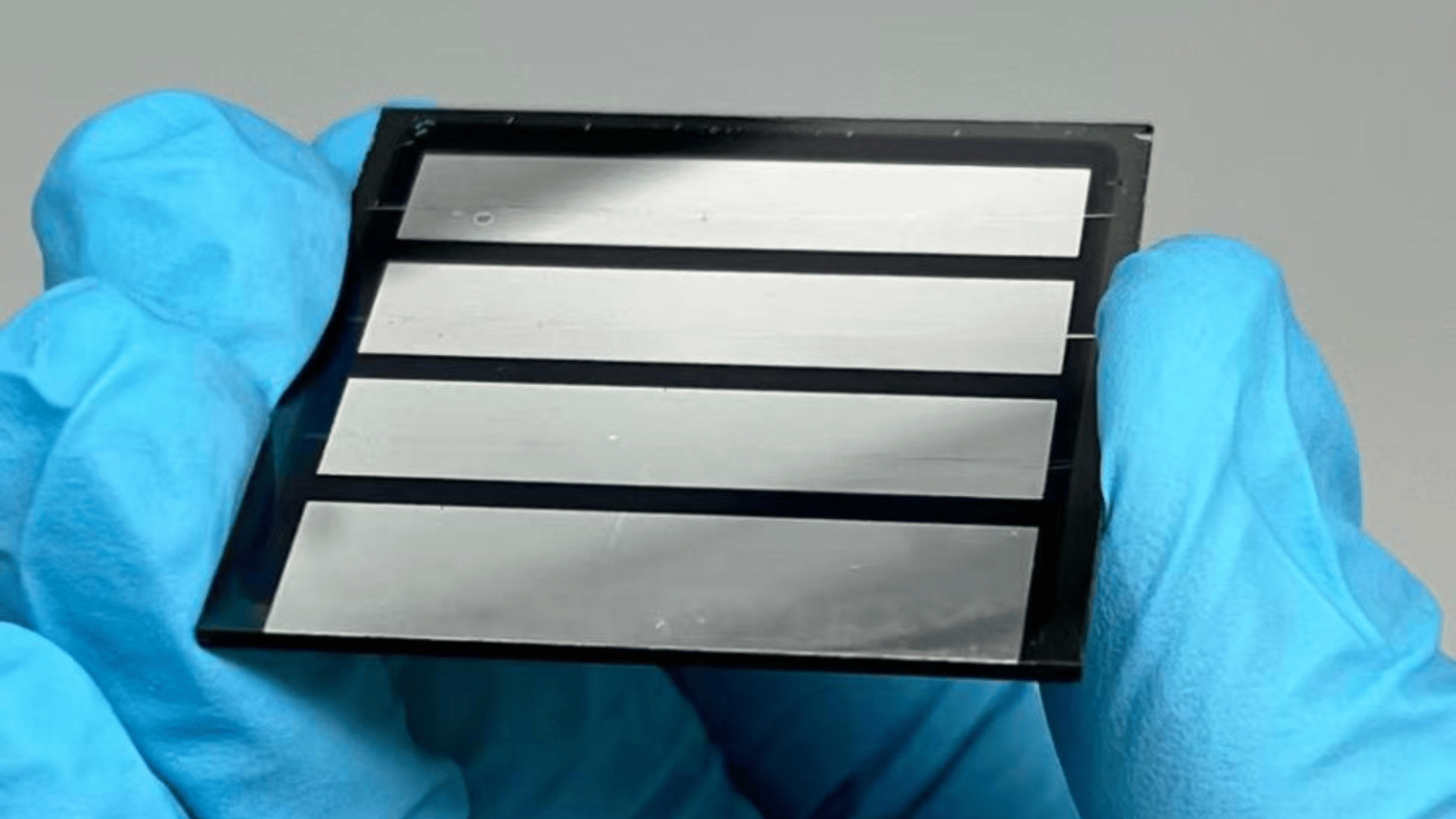
The issue with perovskite has always been its sensitivity. It’s great at catching sunlight, but heat and light usually cause the material to degrade quickly. The researchers solved this by coating the surface with these new molecules, which create a protective layer that stops tiny defects from forming. Additionally, the protective layer helps electricity flow smoothly through the cell.
Advertisement
According to the scientists, the layer is so stable that the solar cells don’t just work better, they last longer. In tests, the team’s cells reached an efficiency of 25.4%. Impressively, they kept 95% of that power after being baked at 185°F (85°C) under constant sunlight for over 1,100 hours.
A Path to Cleaner Energy
Scientists say that this discovery matters because it moves solar tech out of the lab and closer to your neighborhood. If solar panels are cheaper to make and don’t break as often, the cost of clean energy goes down for everyone.
“Perovskite solar cells are seen as a cheaper, lightweight, and flexible alternative to traditional silicon panels, but they have faced challenges with long-term stability,” said Professor Anthopoulos. “Current state-of-the-art perovskite materials are known to be unstable under heat or light, causing the cells to degrade faster.”
“The amidinium ligands we’ve developed, and the new knowledge gained, allow the controlled growth of high-quality, stable perovskite layers,” Professor Anthopoulos added. “This could overcome one of the last major hurdles facing perovskite solar cell technology and ensure it lasts long enough for large-scale deployment.”