When we think about innovation, we often picture electric cars or cloud computing. But some of the most useful technology is happening in the middle of a cornfield. Usually, when a farmer wants to get rid of weeds, they spray the entire field—a method called broadcast spraying. It works, but is wasteful, applying chemicals where they’re not needed.
But that may be changing. A new study from the Weed Science Society of America shows that AI might finally solve this problem.
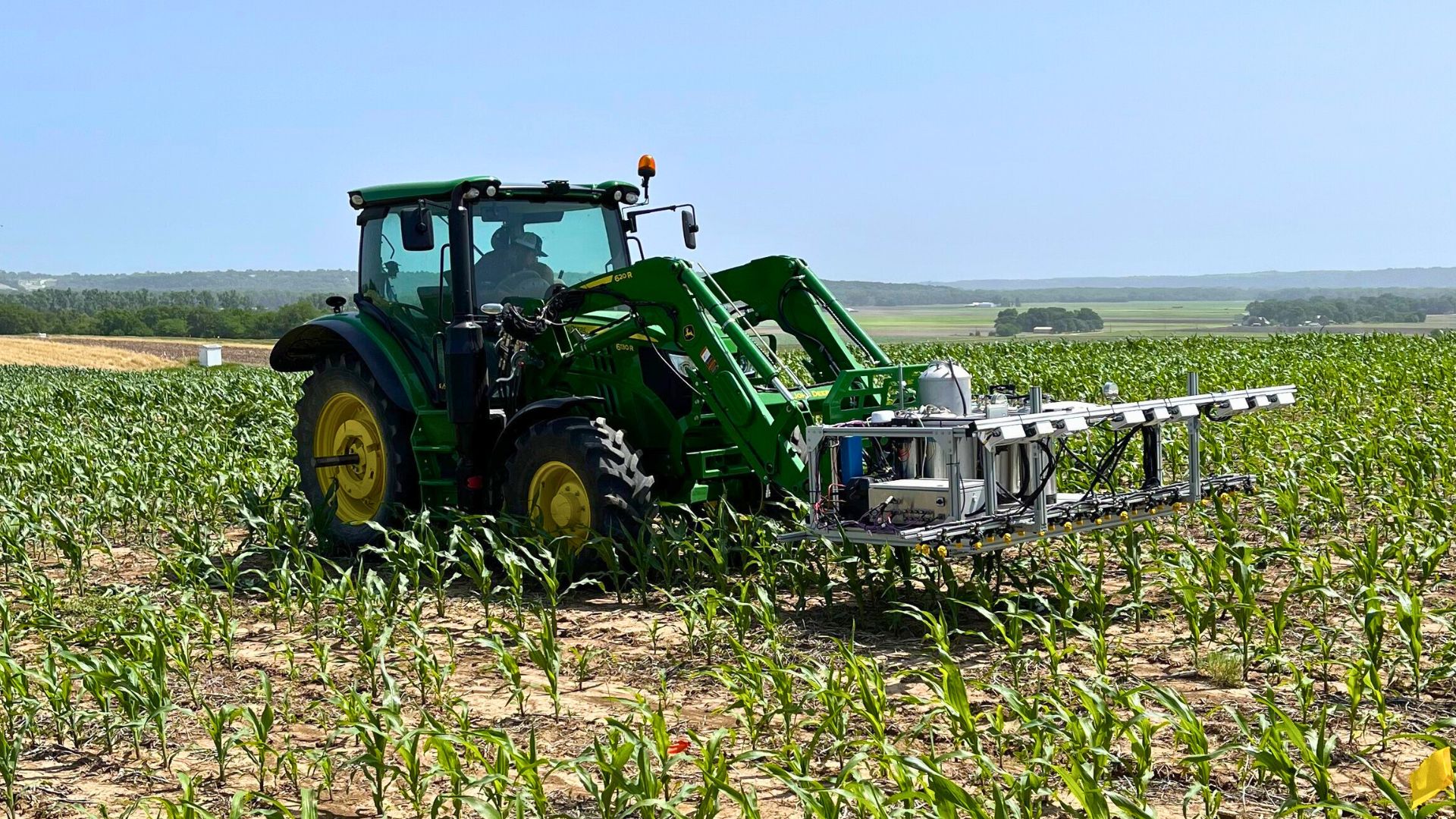
Researchers at Kansas State University tested a system called ONE SMART SPRAY. They attached cameras and sensors to a long boom on the back of a tractor. These aren’t just regular cameras—they use AI to tell the difference between a crop and a weed in real time. As the tractor drives, the AI “looks” at the ground. If it sees a weed, it tells a specific nozzle to spray just that spot. If it sees corn or just empty soil, the nozzle simply stays shut. In the early season, when the ground is mostly brown, the system uses simple infrared sensors to find anything green. But once the crops start growing, the AI takes over. It’s smart enough to see a weed hiding right between rows of soybeans and hit it with a precise shot of herbicide.
Advertisement
The team ran trials in Kansas and Illinois over two years. Here’s what they found: the smart sprayers significantly cut down on the amount of herbicide used. Because the farmers weren’t spraying the whole field, they saved a lot of money on chemicals. Using fewer chemicals is better for the farmer’s wallet, but it’s also better for the land. It keeps unnecessary runoff out of the soil and water.
Technology alone isn’t a “set it and forget it” solution. Anita Dille, the lead researcher, was very clear about one thing: you still need a good plan. “This research demonstrated that significant herbicide use reductions are possible with smart sprayers compared with broadcast applications,” reports Anita Dille, Ph.D., WSSA member scientist, corresponding author, Kansas State University agronomy professor, and her research team. “However, incorporating integrated weed management principles with this technology, which includes crop rotations, use of residual herbicides, ensuring multiple effective sites of action for the dominant weed species, and two-pass herbicide programs, is still very important.” If farmers only rely on one type of spray and one piece of tech, weeds can eventually become resistant to those chemicals. She says farmers still need to rotate their crops and use different types of weed killers.
Right now, most tractors only have one tank. That’s a bit of a hurdle. To get the best results, you really need a “two-tank” system. One tank would spray a base layer of protection over the whole field, while the second tank—controlled by the AI—would target the stubborn weeds that pop up later.