Every autumn, cranberries reach their peak color and flavor. In North America, that harvest runs from mid-September to mid-November, while growers in Chile harvest from March through May.
Ocean Spray, headquartered in Lakeville, Massachusetts, harvests 220 billion cranberries a year. Behind those numbers is an agricultural cooperative started in 1933. Today, 700 small family farms across the U.S., Canada, and Chile collectively own the brand. Together, they produce almost 65% of all cranberries sold.
“The average farm in the cooperative is just 18 acres. These are small family farms, typically multi-generational. In fact, more than a quarter of our farms are in their fourth generation or greater,” said Kellyanne Dignan in a 2019 Business Insider video.
Because it is a cooperative, those family farms see 100% of the profits from Ocean Spray sales.
“Cooperatives support farmers because ultimately farmers can capture a lot more value for their crops,” Dignan explained in the 2019 Business Insider video. “So the value we add through manufacturing and marketing and that blue Ocean Spray brand, all of that’s going back to the farm rather than going to a middleman or a CPG company.”
How Wet Harvesting Works
Many people think cranberries grow underwater all year because they see photos of berries floating on the surface, or they’ve seen the hilariously iconic Ocean Spray commercials like the one above. But cranberries actually grow on vines in wetland fields called bogs. Small pink flowers bloom in June, resembling a crane, which gave the berry its name, before falling off so the fruit can grow.
Advertisement
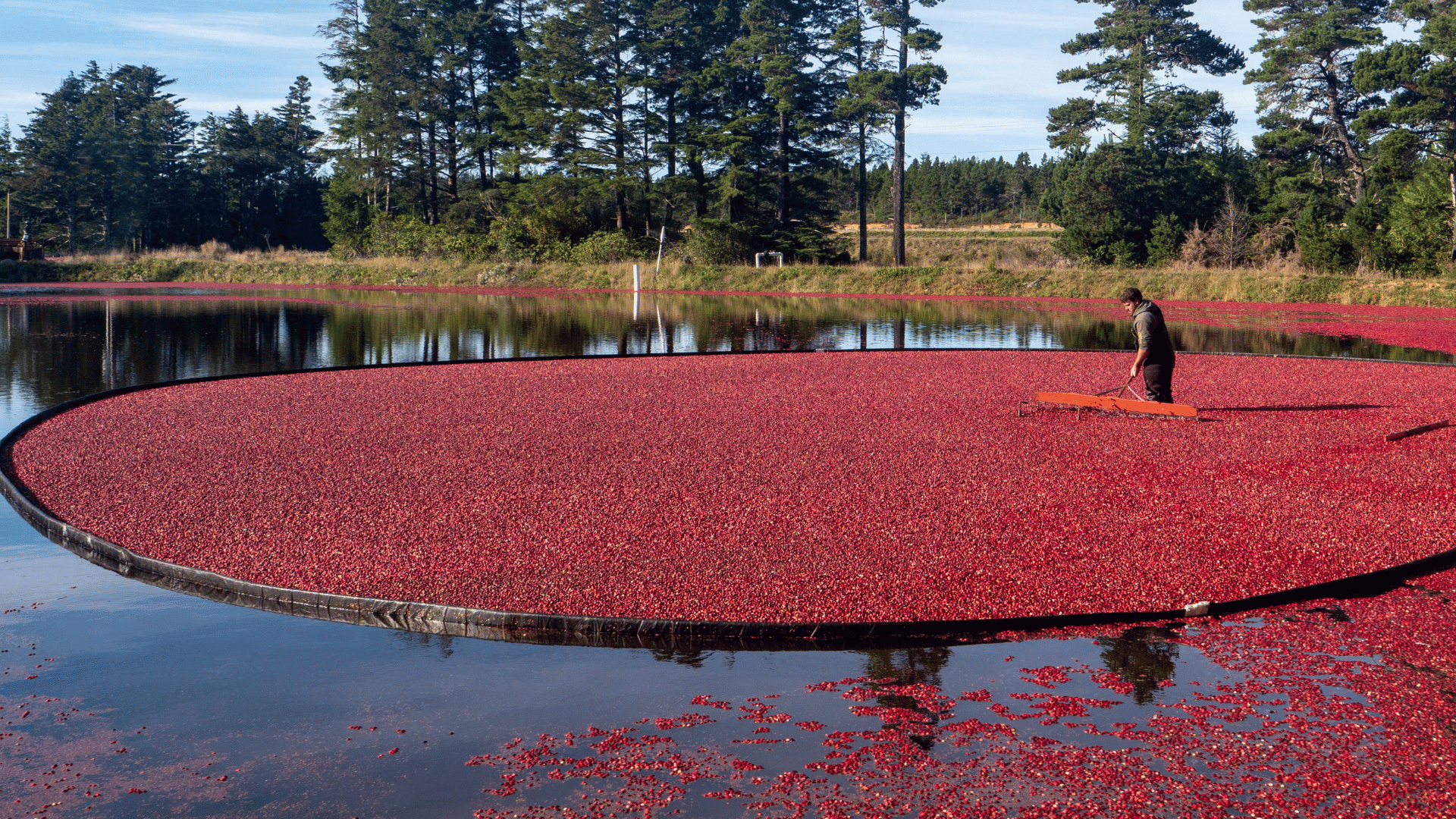
Come harvest time, growers use a technique called wet harvesting. They flood the bog with up to 18 inches of water the night before picking. Next, unique harvesting machines drive in to churn the water and loosen the berries from the vines. Because each cranberry has four tiny air pockets inside, the fruit floats right to the top.
“We try to use Mother Nature as much as we can, and the wind. And in a lot of cases, the cranberries will be pushed to one area of the bog, and that’s the area that we use to take the cranberries off,” said Allison Carr, a sixth-generation cranberry farmer in Massachusetts.
Farmers in waders then use a boom to corral the floating berries into one corner. They rake them into vacuums that suck the fruit straight into trucks.
From Bog to Grocery Aisle
Once loaded, trucks haul the berries to Ocean Spray processing plants. There, the fruit becomes one of 1,000 different products sold across 100 countries. Each year, Ocean Spray facilities turn out roughly 88 million cans of cranberry sauce and 223 million bottles of juice.
Not every berry goes into a bottle or a can, though. The fresh cranberries you buy in the produce aisle every fall get special treatment. Growers either dry-pick them or gently comb them from the vines during a water harvest, then dry them to keep the fruit at peak quality.
 Read Exclusive Stories
 Bookmark & Save Articles For Later