Germany has a problem with its bridges and their durability. Many of the bridges in the country are worn down and require repairs. This spans from major highways to smaller pathways for walkers and cyclists. While the country wants the bridges to be durable, it also wants the infrastructure to be green. Wooden bridges are a good alternative to steel and concrete, but weather impacts them quickly.
Researchers from the Technical University of Berlin (TU Berlin) believe they have a strong sustainable option. The researchers partnered with the engineering firm Miebach to build the world’s first bridge that pairs wood with granite.
Weatherproof
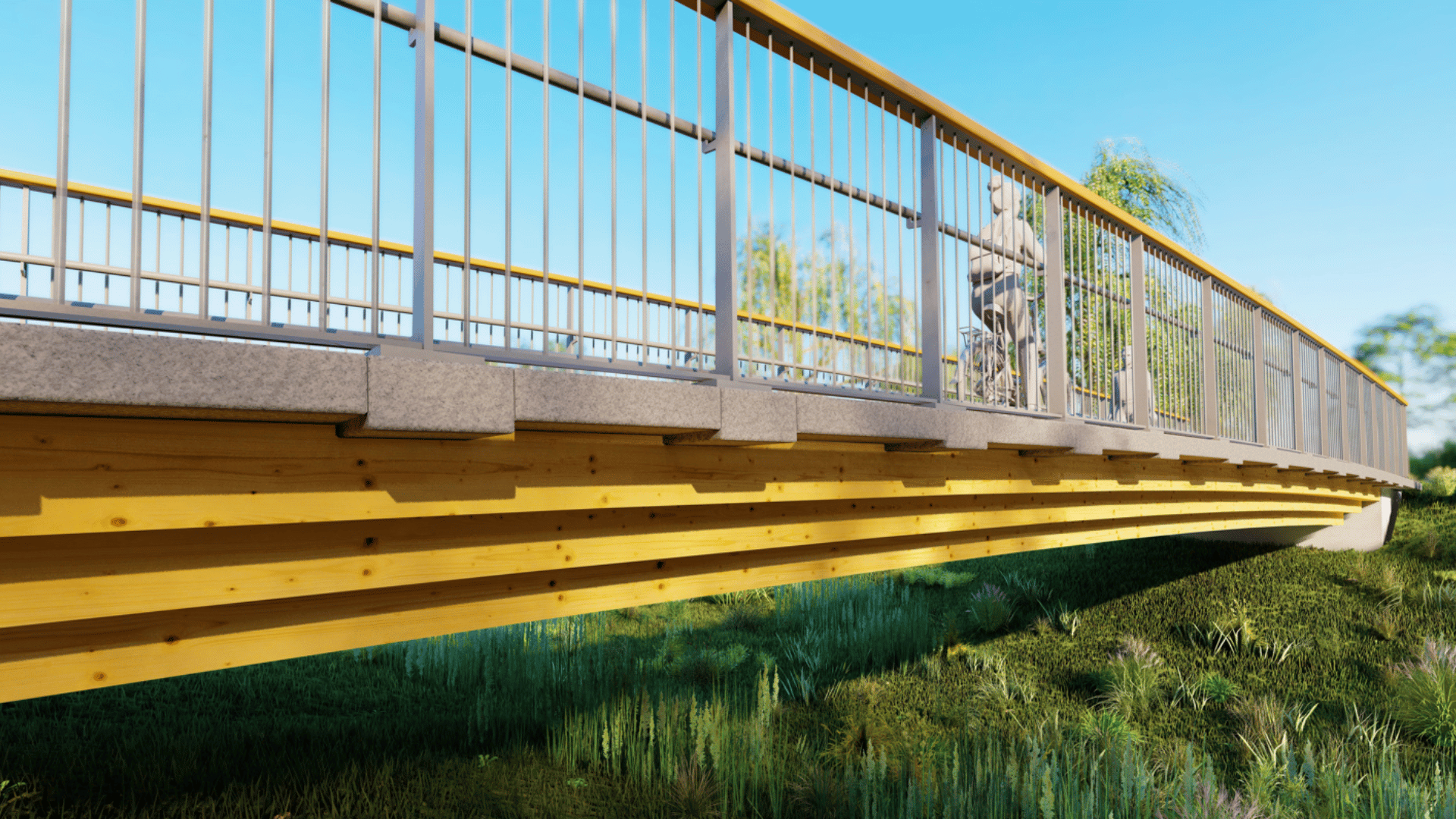
Bridges made of wood and concrete already exist, but concrete creates high carbon emissions. Dr. Volker Schmid from TU Berlin explains why his team swapped concrete for stone.
“Composite bridges made of wood and concrete already exist. However, we use large granite slabs instead of concrete, thus reducing the resulting emissions,” Schmid said. “At the same time, the lifespan and load-bearing capacity are increased compared to a wooden bridge – the wood-granite bridge can therefore be built more slender and elegantly.”
Joining wood and stone was difficult because the materials behave so differently. The team solved this by using granite slabs of different thicknesses that interlock with a tapered wooden beam below. Screws keep the slabs from lifting, and a strong epoxy glues them together.
Advertisement
“Granite slabs form the pedestrian or vehicular section of the bridge. The granite slabs are bonded to each other with a high-strength epoxy adhesive, creating a watertight seal,” Schmid explained. “This results in a weatherproof, dense roadway slab on top, which protects the wood beneath.”
Because the wood stays dry even in heavy rain, the bridge lasts three to five times longer than a standard wooden one.
Built to be Taken Apart
The bridge also reduces construction waste by eliminating the need to demolish an old bridge and discard its pieces. Instead, crews can loosen the screws and take it apart.
“The innovative, detachable connection between wood and granite has a crucial advantage: Almost all materials can be reused in new construction projects if the bridge needs to be renovated or dismantled,” Schmid said.
Miebach is already planning two 15-meter (roughly 50-foot) pedestrian-and-bike bridges using this method in Berlin’s Spandau district.
“In addition to houses and apartments, the infrastructure of the future can also be designed circularly,” German Federal Environmental Foundation representative Sabine Djahanschah said. “Keeping resources in the economic cycle protects the environment and offers financial advantages for developers.”
 Read Exclusive Stories
 Bookmark & Save Articles For Later