Every great invention takes a journey. It starts as a spark in nature, takes shape in skilled hands, becomes something new, and ends up on a production line and in everyday life. In this article, we follow an idea that sticks around, literally: the hook-and-loop fastener, better known by its most famous brand name, VELCRO.
WORLD OF INSPIRATION
In 1941, Swiss engineer and inventor George de Mestral came home from an outing in the Jura mountains with his dog. The World Intellectual Property Organization (WIPO) describes it as a hunting trip; the National Inventors Hall of Fame calls it a walk through the woods and says the dog was an Irish Pointer. The details vary a little, but every source agrees on what happened next. His trousers and his dog’s fur were covered in burdock burrs. Unlike many famous stories of invention, this one is not a legend written down decades later. It is well documented by WIPO and by the company de Mestral founded.
De Mestral was a born tinkerer. He was born in 1907 near Lausanne, filed his first patent for a toy airplane at age 12, and earned an electrical engineering degree from the École Polytechnique Fédérale de Lausanne in 1930. So instead of just brushing the burrs off, he put one under a microscope. It was covered in tiny hooks that caught on the loops of fabric and fur. That’s nature’s clever trick for seed dispersal: the burr hitches a ride on a passing animal and drops its seeds somewhere new.
WORLD OF CREATION
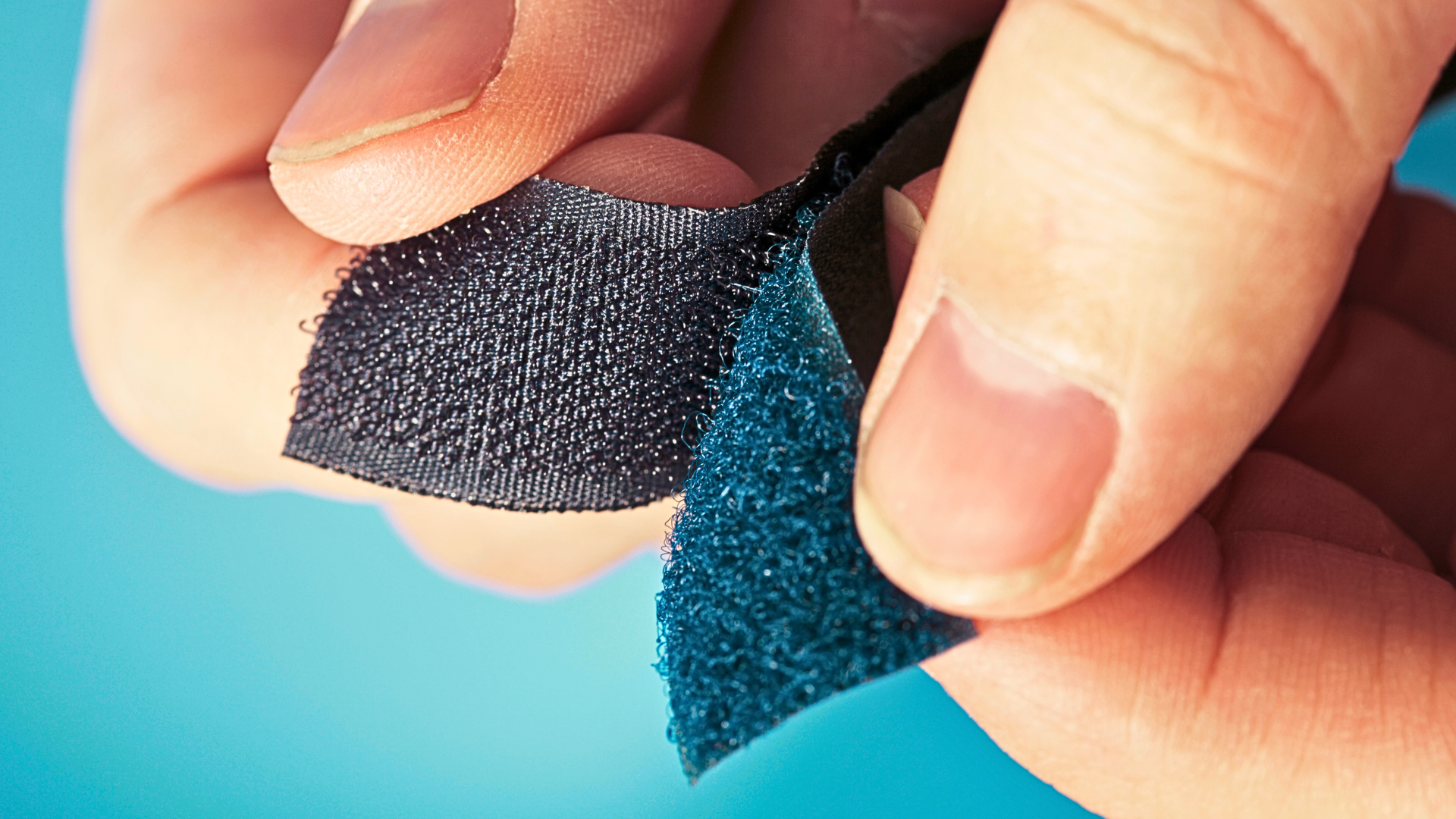
Seeing the idea was the easy part. Building it took years of hands-on work. De Mestral pictured two strips of fabric, one covered in thousands of tiny hooks, like the burr, and the other covered in thousands of soft loops, like his trousers. Pressed together, they would grip. Pulled apart with enough force, they would let go, and unlike a zipper, they would never jam.
Many people laughed at the idea. Working with a weaver from a textile plant in Lyon, France, de Mestral spent years trying to copy the burr in thread. WIPO says it took nearly eight years, and the company’s own timeline puts it at about ten. His early versions used cotton, which wore out too quickly. Nylon turned out to be the answer. It was stronger, held up to repeated use, and could be made in threads of different thicknesses. Nylon hooks could be firm enough to hold yet flexible enough to release.
WORLD OF INNOVATION
Advertisement
De Mestral named the invention by combining two French words: velours (velvet) and crochet (hook). The result was “Velcro.” Today, VELCRO is a protected brand, and the generic name for the technology is simply “hook-and-loop.”
He also knew that protecting the idea mattered, so in 1951, he filed Swiss patent application CH295638, which was granted in 1954. Patents in France and the United States followed in 1955, and the National Inventors Hall of Fame® marks May 13, 1955 as the date of the US patent. Velcro S.A. was founded in Switzerland, and in 1957, a licensing deal granted Velok Ltd. of Canada exclusive rights to manufacture and sell the fasteners in the Western Hemisphere and the Asia-Pacific region. In the 1960s, the two companies merged to form Velcro Industries B.V.
WORLD OF PRODUCTION
A great prototype is useless if you can’t make it consistently and weaving millions of identical hooks by machine was one of the hardest parts of the whole journey. According to WIPO, entirely new machinery had to be built. De Mestral eventually developed new looms and proprietary hook-cutting systems that made mass production possible and set the standard for quality.
Then came the big break! In the 1960s, NASA brought VELCRO Brand fasteners into the Apollo program. On Apollo 11, the fasteners covered about 3,300 square inches of the spacecraft’s interior and exterior, and examples that flew to space are now at the Smithsonian’s National Air and Space Museum. Fashion was a harder sell. WIPO notes that the fasteners were often considered too unattractive for high fashion and ended up mostly on athletic gear and shoes. When the original patent expired in 1978 and competitors rushed in, the company moved into automotive, aerospace, and medical markets. As of 2026, according to WIPO, Velcro Companies has filed more than 2,100 patent applications worldwide, holds 1,332 registered trademarks across about 130 countries, and has offices in more than 20 countries.
A burr only wants to spread its seeds. But one curious engineer looked closer, and that tiny hook went on a remarkable trip. Nature supplied the pattern, patient hands wove it into fabric, smart thinking and patents turned it into an invention, and factories carried it from a Swiss hillside to children’s sneakers and all the way to the Moon.
Sources: WIPO IP Advantage, “From a Mountain Walk to 2,100 Patents: The Velcro IP Story” (https://www.wipo.int/en/web/
 Read Exclusive Stories
 Bookmark & Save Articles For Later