The U.S. Department of Energy (DOE) announced a new Phase II Genesis Mission award to ramp up the efforts to build virtually limitless energy. Under the new project, private companies, universities, and other national labs will create a digital twin platform for fusion power.
Leading this national push is Commonwealth Fusion Systems and its digital twin technology. This digital twin will be a computer model that directly links to the company’s fusion demonstrator device SPARC. The digital twin will always be connected to the physical fusion machine. As a result, it will constantly update itself to make better predictions.
Researchers will use what they learn from the digital twin and the physical testing to design ARC, which will be the company’s commercial fusion power plant.
A Testbed for Commercial Fusion Energy
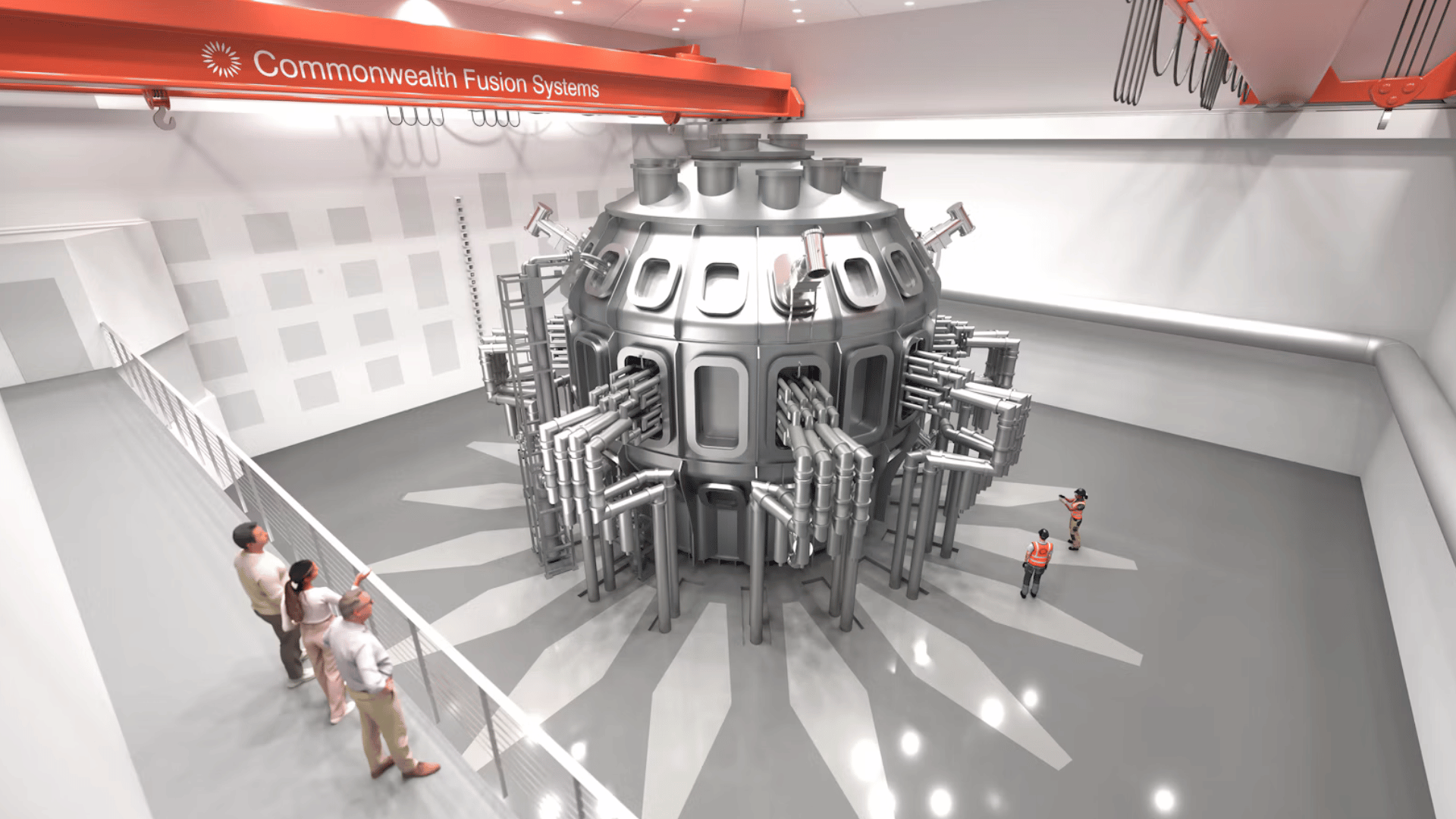
Running a fusion experiment requires immense processing power. Traditional computer simulations are too slow for what the experiments require. This project aims to deliver accurate predictions in under 20 minutes. That speed lets researchers analyze results right between plasma pulses inside SPARC, a tokamak machine that uses magnetic fields to hold superhot plasma in place.
PPPL is one of the many national labs involved in the project. It brings its own physics codes, software knowledge, and historical experiment data to the table. Scientists will test out digital twin workflows on PPPL’s primary experiment, the National Spherical Torus Experiment-Upgrade (NSTX-U), before applying them to SPARC.
Advertisement
“PPPL will play a central role in this project, contributing foundational software engineering and SI models, core physics models, historical tokamak data and high-performance compute resources,” said Michael Churchill, head of PPPL’s AI for Science Group.
A National Effort
Building a working fusion grid demands help from every corner of tech and science. Three other U.S. national laboratories are joining the team: Oak Ridge, Lawrence Livermore, and SLAC. They are partnering alongside MIT, Carnegie Mellon University, General Atomics, NVIDIA, Google DeepMind, and Synopsis.
It all fits into the broader Genesis Mission, a nationwide effort using the DOE-built American Science and Security Platform to solve huge problems in energy and health.
“PPPL has extensive breadth of measured plasma data across multiple fusion devices, which is coupled to leading edge theory and computational knowledge and tools,” said Laura Berzak Hopkins, PPPL’s deputy director for research and chief research officer. “Building curated sets of that experimental data plus advancing the tools that utilize it will lead to the delivery of new capabilities for the fusion community to accelerate fusion energy research as a whole.”
 Read Exclusive Stories
 Bookmark & Save Articles For Later