The Amazon Rainforest is one of the most remote places on the planet. A new power plant is being built in the rainforest as a reliable backup for renewable energy options.
Brazil expects to supply more than 85% of its electricity by 2035, but wind and solar power have their limitations. The new Azulão I thermal power plant, built by Eneva, uses a GE Vernova gas turbine to step up when renewable output drops.
Putting a Power Plant in the Amazon
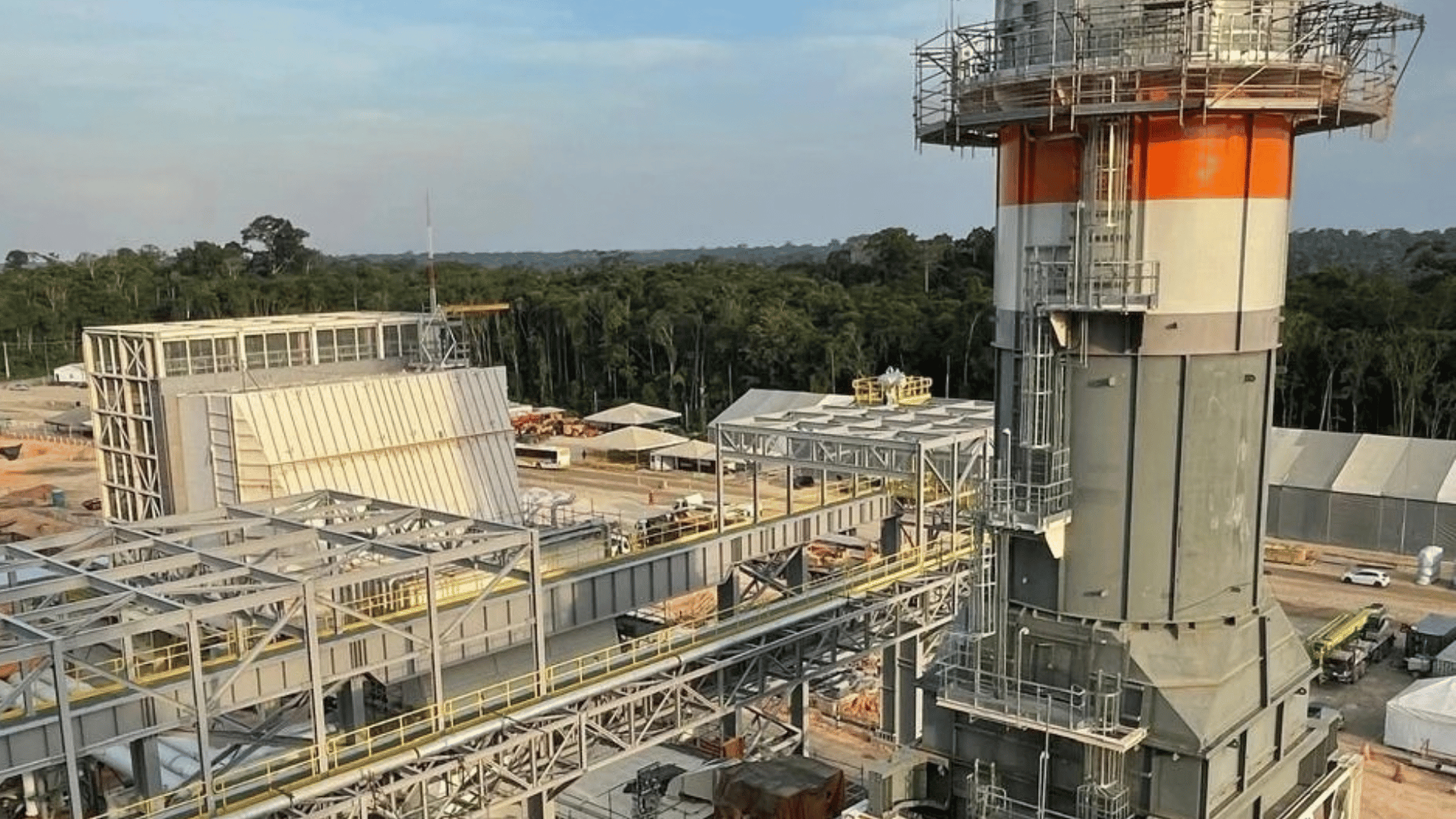
Putting a power plant in the Amazon brings a specific challenge. Azulão I feeds into a 1,200-mile transmission line. Pushing electricity that far requires series capacitors. The problem with these devices is that they can cause a major issue called sub-synchronous resonance, or SSR. SSR creates energy oscillations that can cause blackouts or even snap a generator’s massive shaft in half.
To fix this, GE Vernova engineers built a custom blocking filter right into the generator before the plant even turned on.
“An off-the-shelf component would not account for these site-specific resonances,” explained José Geraldo Barreto Monteiro de Andrade, managing director for Latin America at GE Vernova’s Consulting Services. “A tailored solution was necessary to ensure the filter was ‘in tune’ with the risk profile of the turbine generator units.”
Advertisement
One Energy System
Usually, these filters get added after parts start breaking. Here, engineers treated the plant and the power lines as a single connected machine from day one.
“Azulão I demonstrates what becomes possible when generation technology, grid-power stability technology, and system-level engineering are considered together from the outset,” said Ivette Castillo, general manager of Grid Systems Integration for GE Vernova in Latin America. “By treating the power plant and transmission network as one system, we were able to identify critical interactions early, engineer the right protections and solutions into the project, and, most important, protect the system.”
Castillo added, “Instead of reacting to an SSR problem after the plant entered service, the team addressed it while the system was still being engineered — an outcome enabled by Eneva’s trust in GE Vernova’s expertise.”
When the next phase, Azulão II, is finished in 2027, the complex will generate enough electricity for four million homes.
“Providing dependable power when renewables fluctuate makes flexible gas generation a critical complement to lower-carbon technologies,” said Marco Vera, general director and VP of new units for GE Vernova’s Gas Power business in Latin America and the Caribbean. “This project demonstrates how combining flexible power with modern grid solutions creates a more resilient, balanced energy ecosystem.”
 Read Exclusive Stories
 Bookmark & Save Articles For Later