A robot checking a coastline or a flooded street is usually required to crawl over a hard surface, climb a bank, or slide into the water within just a few feet. This is often quite the challenge for a bot.
For example, most snake-like robots handle changing terrain by adjusting their locomotion or by using extra parts. That can complicate things and create more opportunities for the robot to break down.
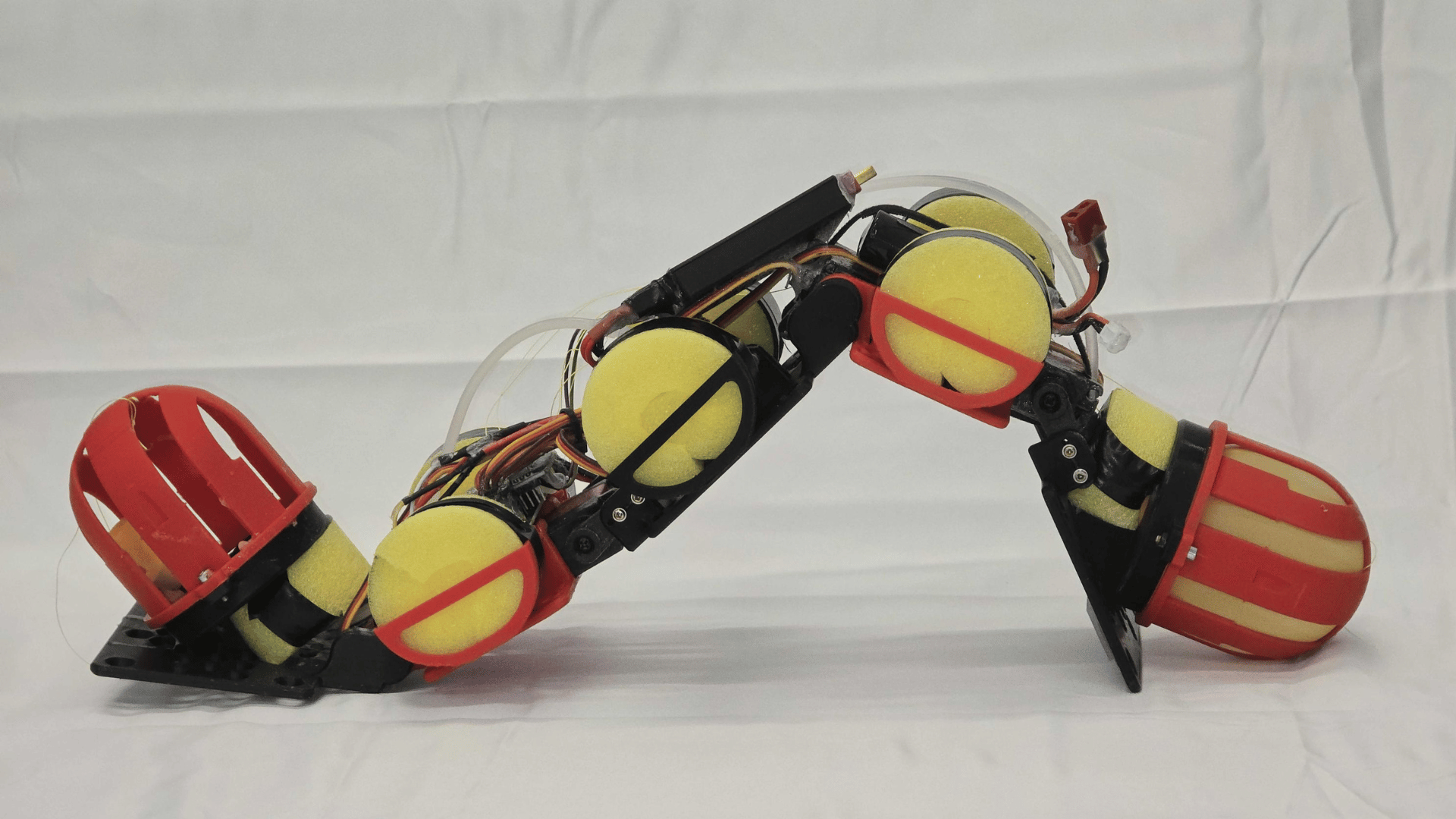
Researchers at NYU Tandon developed a new kind of robot called WorMa, a name that combines “worm” and “mass.” Assistant Professor Nana Obayashi and Ph.D. student Daniil Filimonov designed it to keep the same slithering motion across all terrain. Instead of changing its shape, it shifts its weight.
“The mechanism itself isn’t tied to any one job,” said Obayashi, who serves on the faculty of the NYU Center for Robotics and Embodied Intelligence. “What it gives you is a robot that doesn’t need to be redesigned every time the terrain changes. That could matter for environmental monitoring or infrastructure inspection, where a robot may need to cross dry ground, obstacles, and water during the same mission.”
Moving Water to Move Around
Advertisement
WorMa is a five-link robot about 20 inches long and about two pounds heavy. Inside its head and tail are latex balloon water tanks—a pump in the middle moves about 300 grams of water back and forth.
Where that water sits changes what the robot can do. If it needs to climb a steep hill, it pumps water to its head, which presses the front down for better traction, letting it climb a 19.5-degree slope. In water, however, it swims up to 26% faster and is 52% more efficient when the weight is shifted to its tail.
Climbing Steps
Getting over a step takes a bit more work. WorMa approaches a 6-inch step with a heavy head. Then it shifts water to its tail to push up, hooks its head on the edge, and shifts the water back to the front to pull itself over. To get out of the water, it also needs to keep the weight at its head.
By redistributing its water weight, WorMa can cross flat ground, climb steps, and swim in a single trip. The researchers say it is the first time a slithering robot has managed to both enter and exit water on its own.
Right now, the robot is being upgraded with faster pumps and sensors, which could help it automatically adjust its weight in the future.
 Read Exclusive Stories
 Bookmark & Save Articles For Later