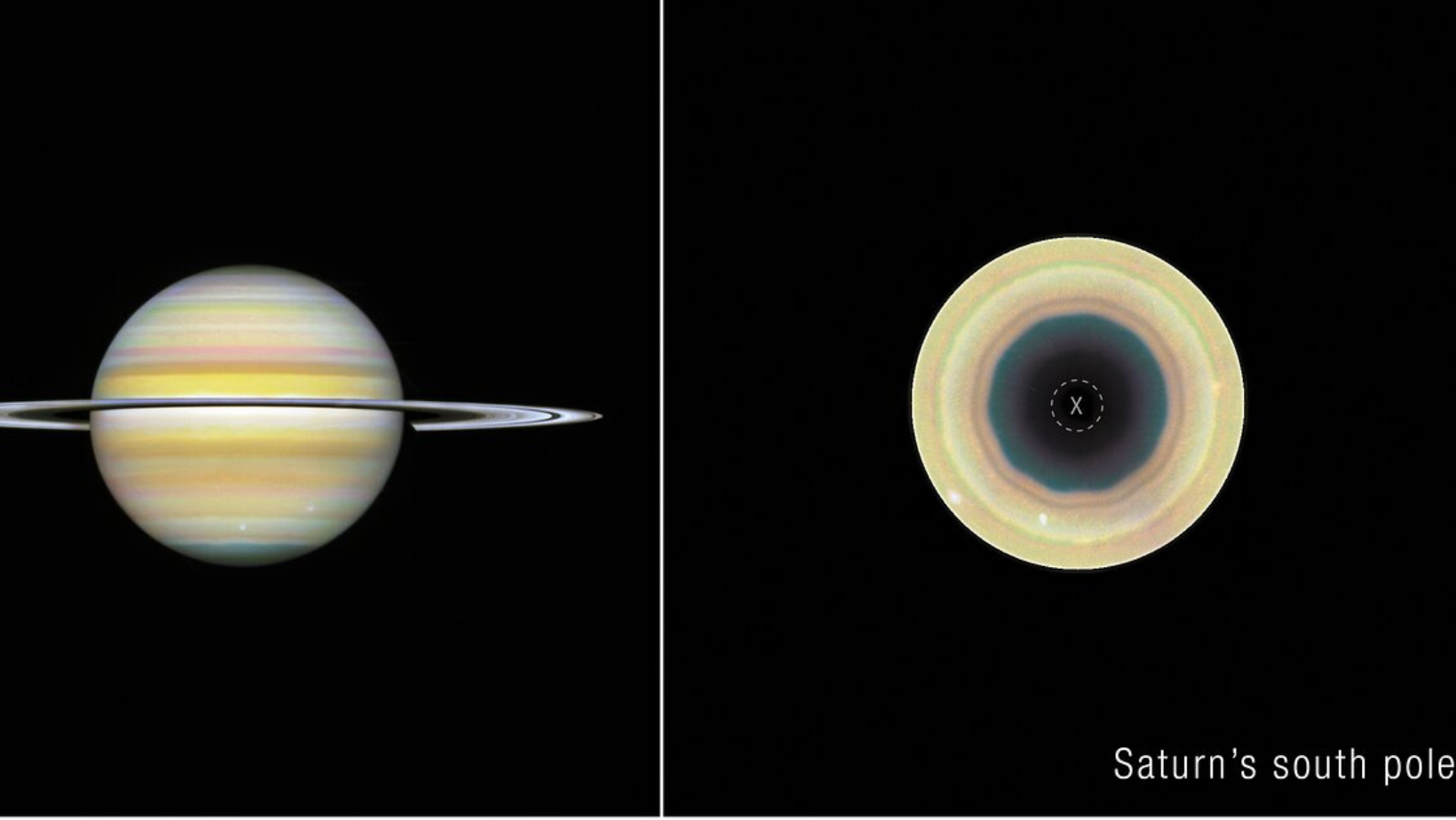
Saturn has always had its share of beautiful rings. But new research has found something else happening on Saturn. A huge 10-sided vortex, or decagon, in the atmosphere of Saturn’s south pole was observed by the Hubble Space Telescope recently.
A six-sided shape, or hexagon, has been known to exist in the atmosphere of Saturn’s north pole for many years. However, a regular polygon like this has never been observed in the South Pole.
How the Shape Was Discovered
This discovery was the result of collaboration between amateur and professional astronomers. Saturn goes through long periods of seasonal change. Recently, the South Pole has turned back towards Earth, allowing it to be observed.
In 2024 and 2025, keen amateur observers noticed, while looking at ground-based images, a thin, wavy feature near the southern pole. Researchers then turned to Hubble to investigate. Hubble can take extremely high-resolution images because it is in space, above the distorting Earth’s atmosphere. Upon analyzing Hubble data, researchers found the decagonal shape and determined that it has been appearing since at least 2023.
Advertisement
Analysis of the data also revealed that this feature is not simply a thin surface layer of clouds. Instead, the 10-sided wave is found within one of Saturn’s strong jet streams and penetrates through many levels of Saturn’s atmosphere.
A Rare Opportunity To Observe A Storm Form
Unlike the well-known hexagon at the north pole, which has remained constant and observable for over 40 years, this decagon at the south pole appears to be a relatively new feature.
What is most exciting about this finding is the timing. For the first time, astronomers have the opportunity to observe a large weather system form in real time. Right now, the decagon seems to be intensifying, but scientists do not yet know whether it will become a permanent feature or a temporary storm.
Scientists will continue to use both the Hubble Space Telescope and the James Webb Space Telescope to observe the South Pole in the years ahead to study the evolution of this wave. Insights gained from this newly discovered decagon could yield significant information about large weather systems, both in space among the giant planets and here on Earth.
 Read Exclusive Stories
 Bookmark & Save Articles For Later