Managing glaucoma is tricky because it all comes down to eye pressure, or intraocular pressure (IOP). If IOP gets too high for too long, it can cause permanent blindness. Right now, checking your eye pressure usually means a trip to the doctor’s office to use a large, stationary machine. That means most patients have no way to track their eye pressure the rest of the day.
However, a research team in Japan has developed a way to change that. They’ve developed a thin-film sensor that fits directly onto a standard contact lens, enabling real-time monitoring while people go about their daily lives. This is especially important in places like Japan, where the aging population means more people are at risk for these types of eye complications.
Making Technology Comfortable
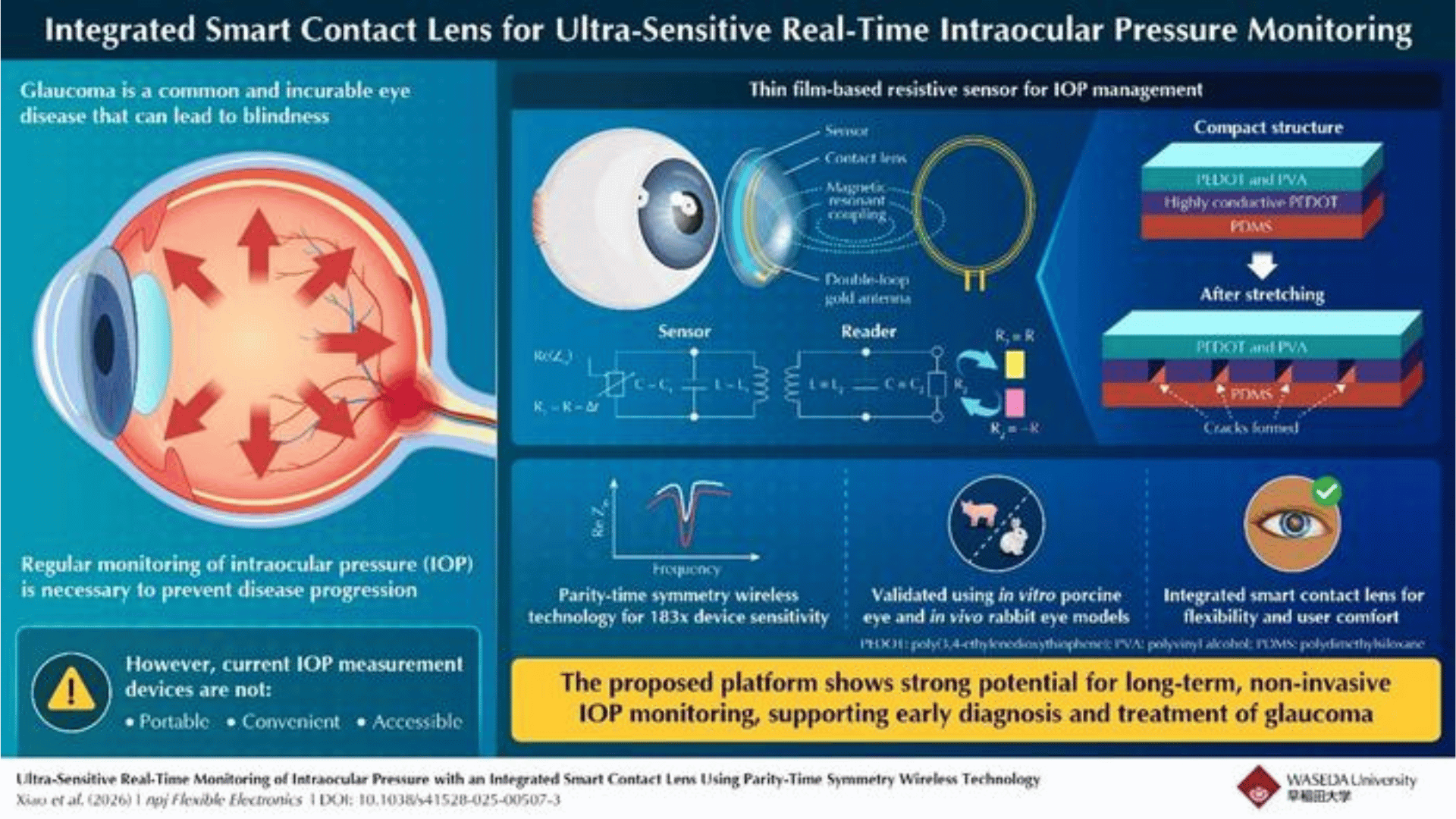
Professor Takeo Miyake and his team at Waseda University wanted to create a sensor that people would actually want to wear, not just any sensor. They used a material called PEDOT:PSS to make a flexible, cracked thin-film sensor, and added a small gold antenna so it could send data wirelessly.
One of the biggest hurdles was making the device sensitive enough to be useful without making it too big or uncomfortable. By using something called parity-time-symmetric wireless technology, they managed to make the device 183 times more sensitive than older wireless systems.
Advertisement
“It is generally very challenging to fabricate a device on a contact lens due to the size limitations while maintaining user comfort,” Professor Miyake explained. “To address these limitations, we used microfabrication to fabricate an IOP sensor that fits well on the contact lens while maintaining flexibility and user comfort.”
“Moreover, the use of parity-time symmetry allows for much higher sensitivity in wireless detection, making this work a major step towards the future of daily, real-time ocular health monitoring devices,” Miyake added.
Testing for the Future
The researchers tested the lenses on pig and rabbit eyes. According to the researchers, the lens was as accurate as the professional tonometers used in clinics. This clever engineering turns an ordinary contact lens into a simple health monitor for a complex problem.
“Overall, our platform is promising for long-term, non-invasive IOP monitoring, thus making a significant contribution to the early diagnosis and treatment of glaucoma,” Professor Miyake concluded.
 Read Exclusive Stories
 Bookmark & Save Articles For Later