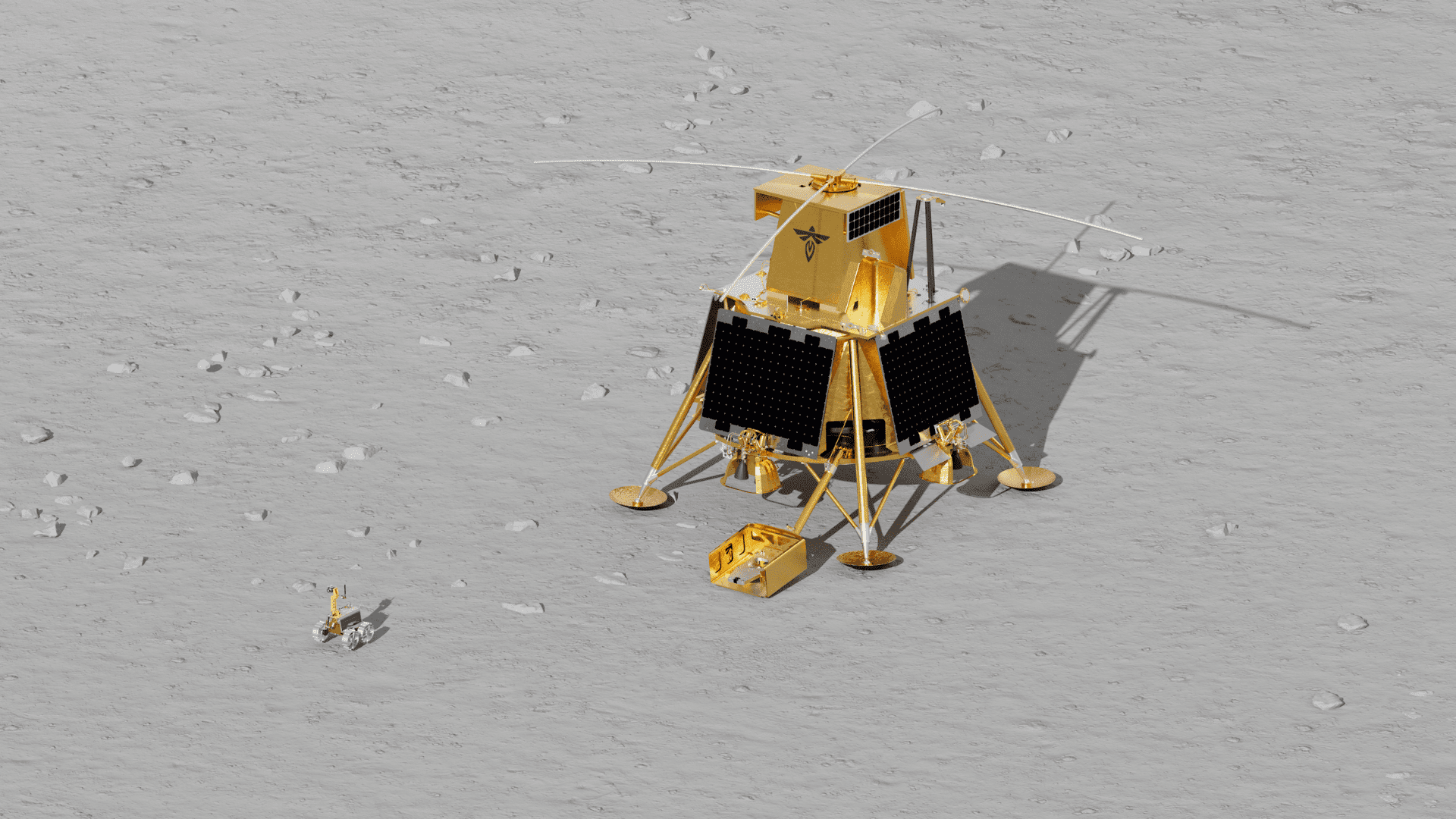
Firefly Aerospace has announced a new commercial payload agreement with Volta Space Technologies to integrate a critical piece of power infrastructure onto Firefly’s Blue Ghost Mission 2 lunar lander, bound for the far side of the Moon. The partnership focuses on validating Volta’s ambitious plan for a sustained lunar energy system, known as LightGrid.
Specifically, the hardware hosted on the Blue Ghost lander is the Volta’s LightPort wireless power receiver. This payload is supposed to be a crucial technology demonstration that proves its ability to survive the harsh lunar night environment. Ultimately, the company wants it to support a comprehensive lunar orbit power grid.
Volta’s LightGrid leaders envision a future where satellites in lunar orbit harvest solar energy and transmit it via laser to surface receivers, or LightPorts, integrated into landers, rovers, and permanent lunar infrastructure. The LightPort demonstration on Blue Ghost Mission 2 will test and validate this first lunar receiver. Additionally, it will show how surface users can, hopefully, access Volta’s power grid reliably.
A Lunar Power Grid
The mission will also demonstrate the receiver’s potential for integration into centralized surface power generation architectures. For example, enabling local power distribution and providing redundant energy capabilities as the lunar ecosystem grows.
Advertisement
“Firefly is proud to welcome Volta to our second Blue Ghost mission and serve as a core partner in the ongoing development of lunar power utilities,” said Jason Kim, CEO of Firefly Aerospace. “Our international mission will enable critical technology demonstrations that lay the groundwork for lasting operations on the Moon.”
Looking ahead, Kim envisions a lunar power network.
“Longer term, our Blue Ghost landers and Elytra orbiters are well equipped to support Volta’s larger vision for a lunar power network, and we look forward to seeing the evolution of our collaboration in the years ahead,” he said.
“Partnering with Firefly on Blue Ghost Mission 2 is an important step forward for Volta and the future of lunar infrastructure,” added Justin Zipkin, CEO of Volta. “This collaboration allows us to prove our LightPort receiver in a real lunar environment and move one step closer to delivering a fully integrated power grid for the Moon.”
With Volta’s LightPort, the Blue Ghost Mission 2 now carries six payloads originating from five different countries. This international mission includes NASA’s LuSEE-Night radio telescope, the European Space Agency’s Lunar Pathfinder satellite, and the United Arab Emirates’ Mohammed Bin Rashid Space Centre Rashid Rover 2.
 Read Exclusive Stories
 Bookmark & Save Articles For Later