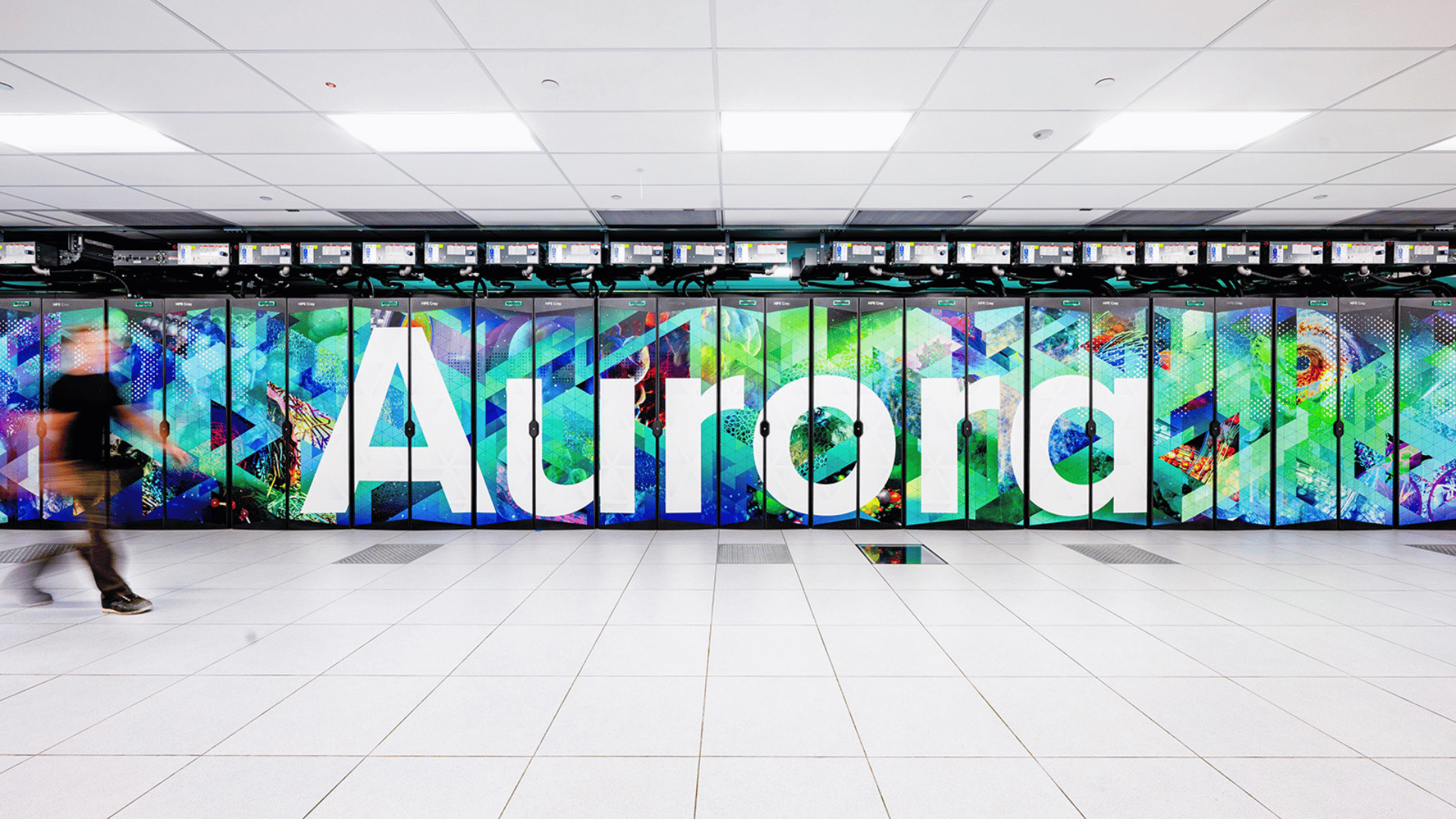
If you wanted to build a star on Earth to use its energy, you’d first need to figure out how to hold onto it without things going wrong. For decades, scientists have been trying to make fusion energy a reality. Now, they have the massive Aurora supercomputer at the Argonne National Laboratory.
Aurora is one of the three fastest computers in the world. It can handle a billion billion calculations every second. This “exascale” speed is exactly what researchers need to solve the tricky physics of fusion, which involves heating gas into an electrified state called plasma.
Extremely Fast Supercomputer Simulates the Sun
To get fusion to work, scientists use doughnut-shaped machines called tokamaks. Inside, they try to join atomic nuclei together to release energy, the same process that powers the Sun. The problem is that the plasma inside a tokamak needs to reach 150 million degrees Celsius, which is ten times hotter than the center of the Sun.
Because it’s so hot and volatile, the reaction can easily flicker out or damage the machine. Scientists are using the Aurora supercomputer to run simulations that predict these issues before they happen.
Advertisement
”Even just regular fluids are a very complicated scientific problem that we use supercomputers for,” said Kyle Felker, an assistant computational scientist at Argonne. “When they become turbulent, it’s very chaotic, and it’s hard to predict what they’ll do.”
“In tokamaks, we’re complicating this by adding magnetic fields and trying to bring this magnetic fluid up to extreme conditions that don’t occur anywhere on Earth,” Felker added.
Using AI to Keep the Lights On
One project uses artificial intelligence to give the machine a “disruption score.” By looking at data from past experiments, the AI can sense if the plasma is about to become unstable within milliseconds. This helps researchers avoid accidents that could shut down the reactor.
Other researchers are using the Aurora supercomputer to look at the “edge” of the plasma, where it hits the walls of the container. Even tiny bits of dust or metal falling off the wall can ruin the reaction. Aurora’s massive memory allows scientists to run these complex calculations in hours instead of days.
“These machines are not going to do the work for you,” said William Tang, a principal research physicist at the Princeton Plasma Physics Laboratory. “They are powerful tools, but they also tell you what you don’t know. As long as we stay focused and have bright, young scientists engaged in fusion energy, then I’m very hopeful for the future.”