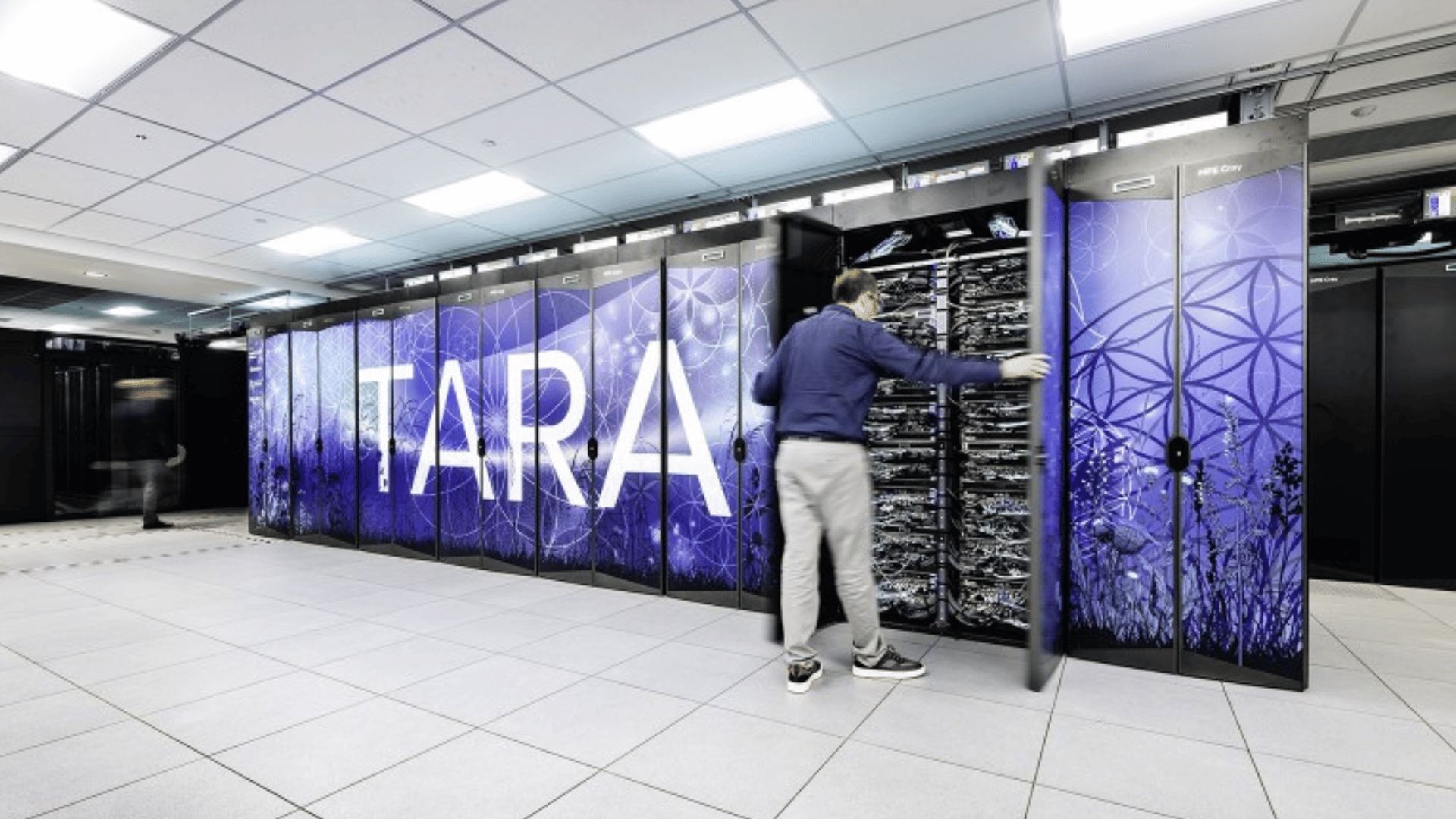
The U.S. Department of Energy’s Argonne National Laboratory is upgrading the computing power behind its Inference Service. Front and center of this supercomputer expansion is a new large-scale system named Tara.
The Inference Service is operated by the Argonne Leadership Computing Facility (ALCF) and gives scientists access to advanced artificial intelligence models. In high-performance computing, inference simply means running a trained model to evaluate data, generate predictions, or solve problems.
Tara, built with Hewlett Packard Enterprise, uses 672 computing nodes and 2,688 NVIDIA GH200 Grace Hopper Superchips. It offers roughly 100 times the GPU memory that was previously available. The lab also added a new system called Minerva with 64 NVIDIA B200 GPUs and expanded its Metis platform to 96 SambaNova SN40L chips.
These join the lab’s existing Sophia platform to support the U.S. Department of Energy’s Genesis Mission, an initiative focused on discovery science, national security, and energy innovation.
“The ALCF has long provided the computing resources researchers need to pursue science at scale,” said Venkat Vishwanath, SI team lead at the ALCF. “As inference and agentic workflows take on a growing role in science, we are evolving to provide new services and tools that complement our computing systems and help scientists be more productive in their research.”
A Supercomputer that Moves Beyond Chatbots
With this extra power, the service now hosts more than 50 models, including large language models and computer vision tools. Scientists can use them through a ChatGPT-like interface or connect them directly to software applications.
Unlike a standard chatbot that just answers questions, an agent connects models with software tools to handle tasks on its own. An agent might write scripts for a calculation, analyze the results, or adjust scientific code to run better.
“We’re moving to a point where agentic workflows are playing a much bigger role in the scientific process,” said ALCF Director of Science Katherine Riley. “We’re seeing researchers put agents to work to connect scientific tools, automate multistep calculations and data analysis, and use experimental results to help determine what to investigate next.”
Researchers are already working on a project called ChemGraph that lets scientists describe a chemistry problem in plain language, and agents plan the simulations. Another project, SYNAPS-I, used vision models to scan a microelectronics sample and automatically locate a specific region between two areas.
Running advanced models takes tons of computing power that most individual teams cannot afford on their own. Sharing the resources enables the lab to make high-end tools accessible to more scientists.
“The opportunity is to make inference a more natural part of scientific workflows involving simulations, data analysis and experiments,” Vishwanath said. “As models and agents continue to advance, they will help researchers tackle more complex problems, work at larger scales and move more quickly from ideas to discovery.”
Advertisement
 Read Exclusive Stories
 Bookmark & Save Articles For Later