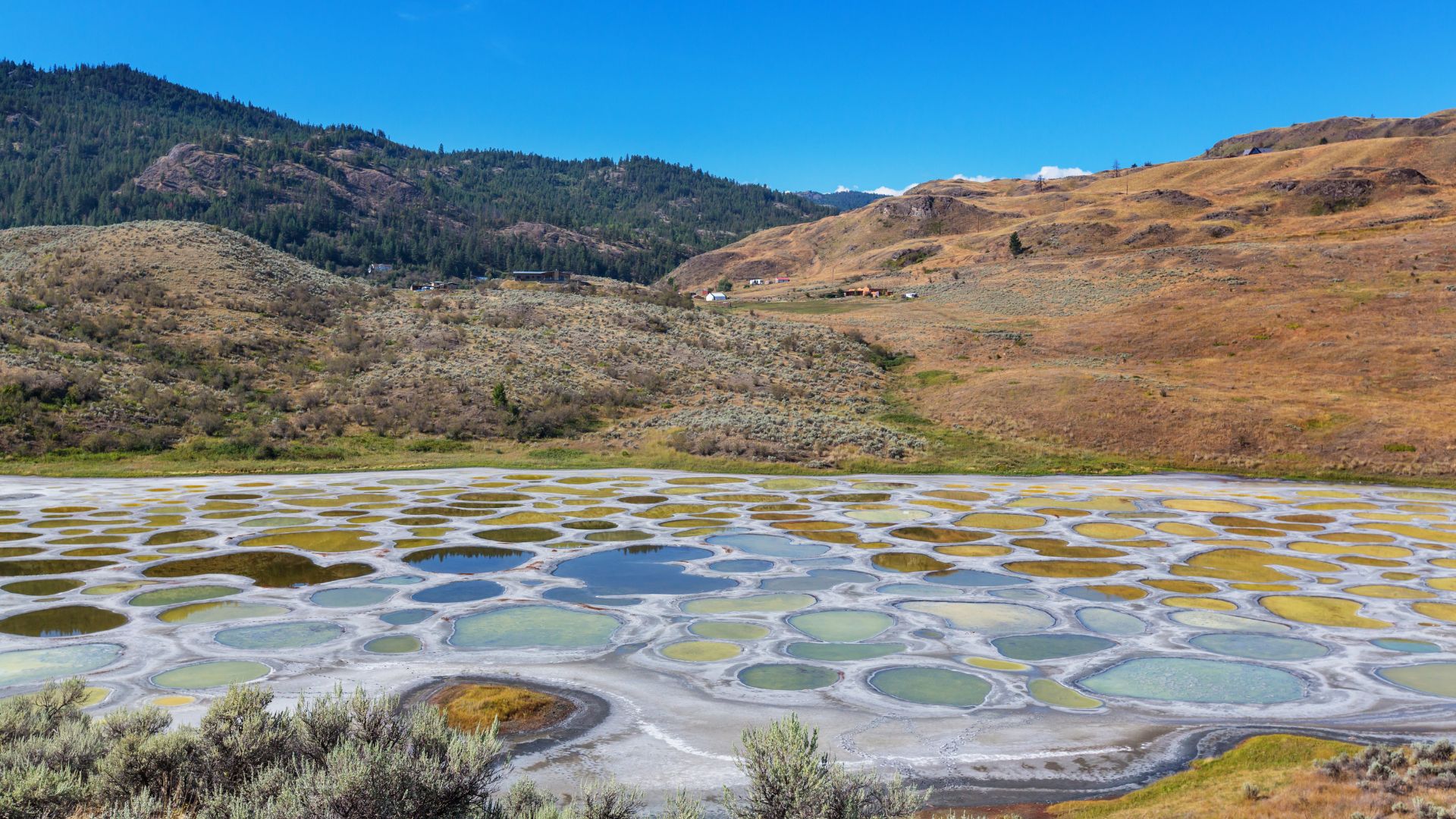
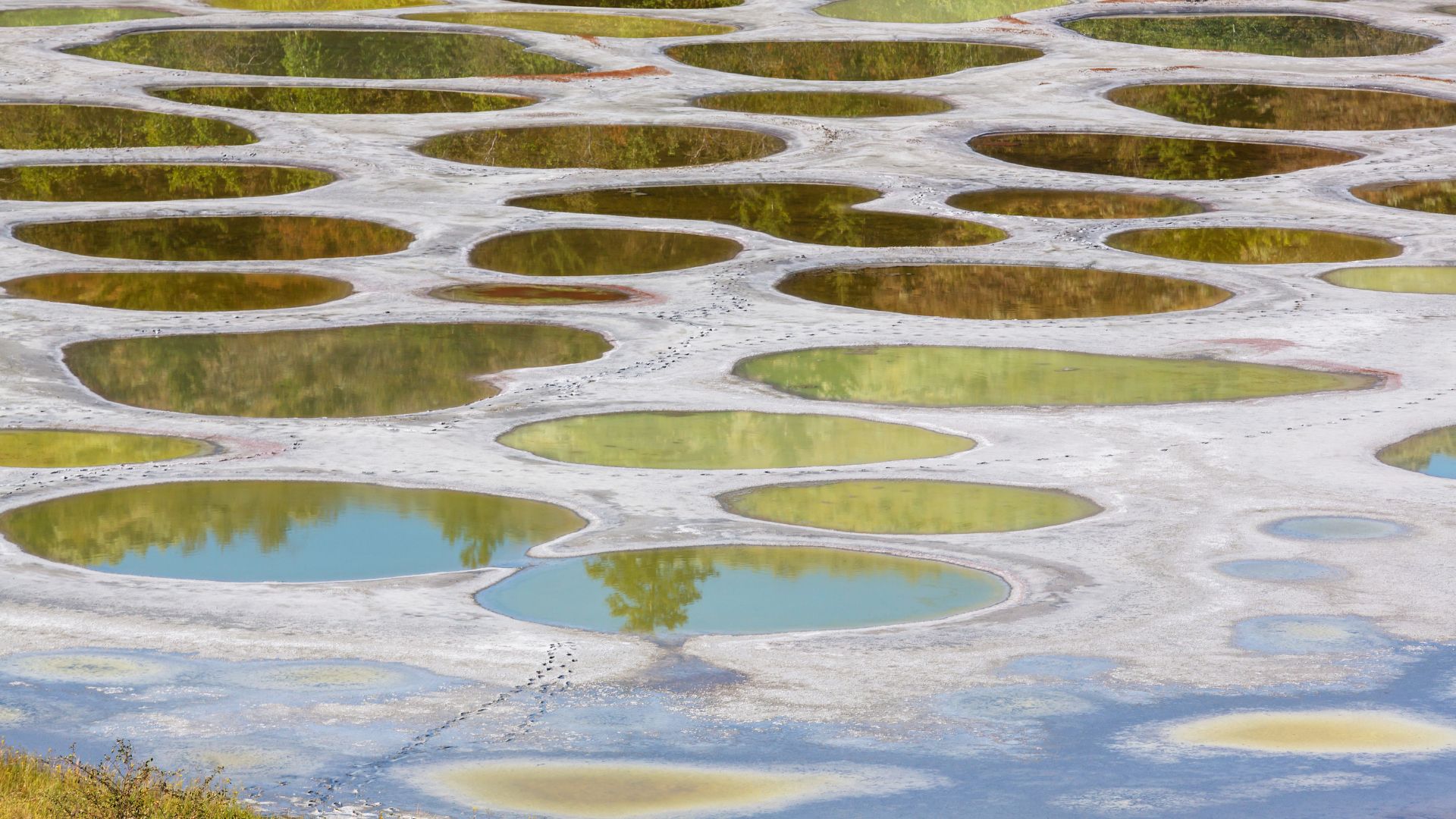
In the dry Similkameen Valley of British Columbia sits Spotted Lake. Most of the year, the lake is as ordinary as any other body of water. However, during the summer months, its waters evaporate, leaving behind a series of yellow, green, and blue circles.
High Mineral Concentrations
The science behind the formation of the spots in the lake is rooted in evaporation and the lake’s geology. The lake does not have any rivers that flow out of it. The minerals from the surrounding hills are carried into the lake by rain and melting snow. During the summer months, the lake loses most of its water to evaporation. The minerals leave the water and form solid walkways between the hundreds of shallow pools within the lake. The minerals that solidify in each pool contain different chemical components that create the yellow, green, and blue spots.
Sacred Healing Waters
Spotted Lake is much more than a destination for visitors from outside of the region. The Syilx people of the Okanagan Nation have long revered the spot as a sacred site for its healing properties. Each of the individual pools contains different medicinal properties. The water, salts, and mud in the lake were used to treat aches and skin ailments among those who visited the lake.
Advertisement
During World War I, the lake was used to prepare tons of salt that would be used to create ammunition for the war’s fighting forces of the Allied nations. The Syilx Okanagan Nation purchased the land surrounding the lake in 2001 to protect it from development. Today, those who travel to the area can pull off Highway 3 to view the spot of healing waters, from a fence established around the site to protect this cultural landmark of the Syilx people.
Mars Analogy Studies
The weird conditions at the lake also attract scientists and space researchers.
Because the water is so salty and dense, very few living things can survive in it. Astrobiologists study the tiny microorganisms living in mud to understand how life might cope with extreme environments in space. Researchers have even compared the mineral deposits in Spotted Lake to ancient dried-up lake beds on Mars, giving us a clue about what water looked like on the Red Planet billions of years ago.
 Read Exclusive Stories
 Bookmark & Save Articles For Later